how has supreme court precedent changed your fifth amendment rights over time? check all that…
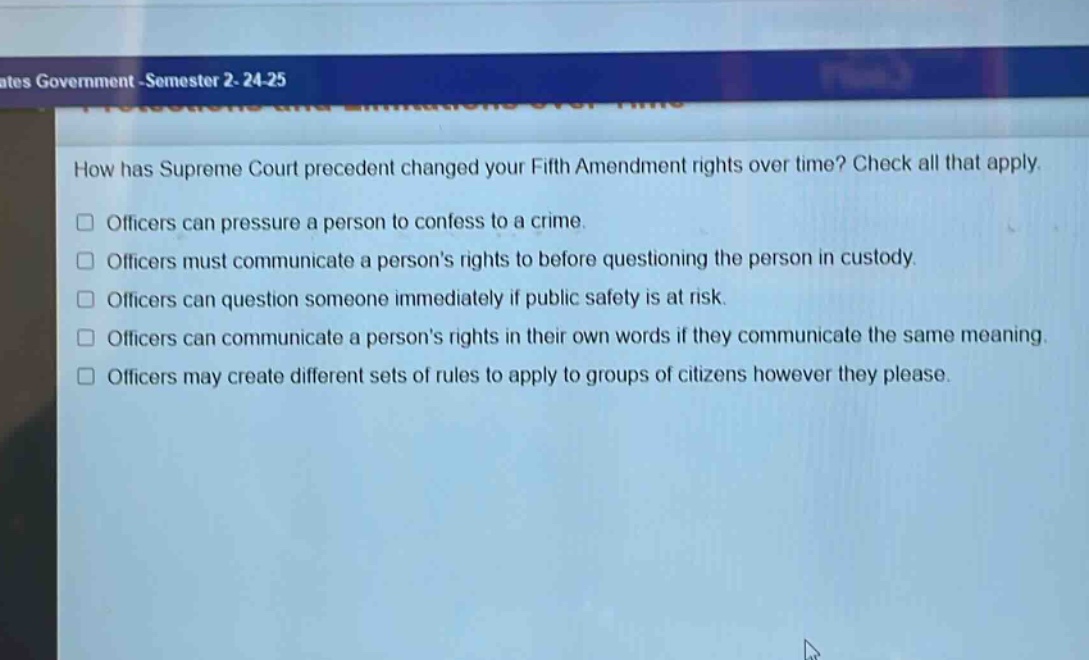
how has supreme court precedent changed your fifth amendment rights over time? check all that apply.\nofficers can pressure a person to confess to a crime.\nofficers must communicate a persons rights to before questioning the person in custody.\nofficers can question someone immediately if public safety is at risk.\nofficers can communicate a persons rights in their own words if they communicate the same meaning.\nofficers may create different sets of rules to apply to groups of citizens however they please.
Answer
Brief Explanations:
The Fifth Amendment includes the right against self - incrimination. Supreme Court precedents like Miranda v. Arizona require officers to communicate a person's rights (Miranda rights) before questioning in custody. Also, in cases where public safety is at risk, officers can question immediately. Officers must communicate rights accurately, not in their own words loosely, and cannot create arbitrary rule - sets for different citizen groups. Pressuring a person to confess violates the Fifth Amendment.
Answer:
Officers must communicate a person's rights to before questioning the person in custody. Officers can question someone immediately if public safety is at risk.