how did the u.s. supreme court rule in plessy v. ferguson (1896)?\nit was against the law to segregate…
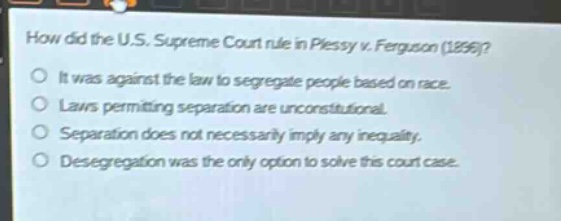
how did the u.s. supreme court rule in plessy v. ferguson (1896)?\nit was against the law to segregate people based on race.\nlaws permitting separation are unconstitutional.\nseparation does not necessarily imply any inequality.\ndesegregation was the only option to solve this court case.
Answer
Answer:
Separation does not necessarily imply any inequality.
Brief Explanations:
In the Plessy v. Ferguson (1896) case, the U.S. Supreme Court established the "separate but equal" doctrine, ruling that racial - segregation laws did not violate the Constitution as long as the separate facilities were equal in quality, thus suggesting separation did not imply inequality.