the supreme courts decisions in terry v. ohio (1967) and horton v. california (1990) both held that the…
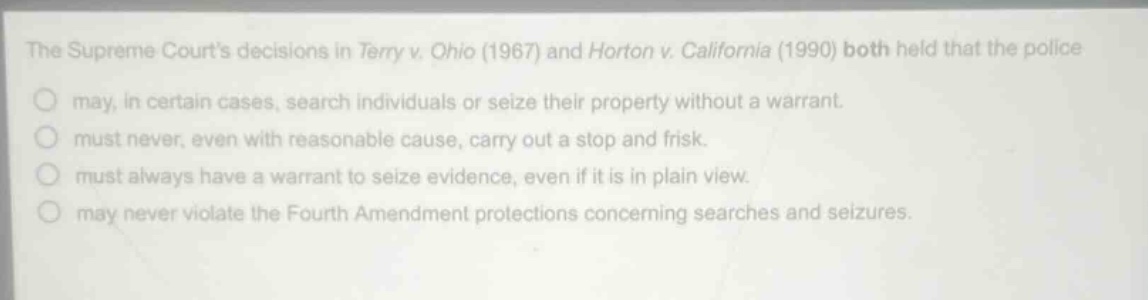
the supreme courts decisions in terry v. ohio (1967) and horton v. california (1990) both held that the police\nmay, in certain cases, search individuals or seize their property without a warrant.\nmust never, even with reasonable cause, carry out a stop and frisk.\nmust always have a warrant to seize evidence, even if it is in plain view.\nmay never violate the fourth amendment protections concerning searches and seizures.
Answer
Answer:
A. may, in certain cases, search individuals or seize their property without a warrant.
Brief Explanations:
In Terry v. Ohio, the Supreme - Court established the "stop - and - frisk" exception allowing police to conduct a limited search without a warrant under specific circumstances. In Horton v. California, the Court held that evidence in plain view can be seized without a warrant in certain situations. These cases show that under specific conditions, police can search or seize property without a warrant.