a teacher asks students to list the math lessons they learned on nine random school days in the past month…
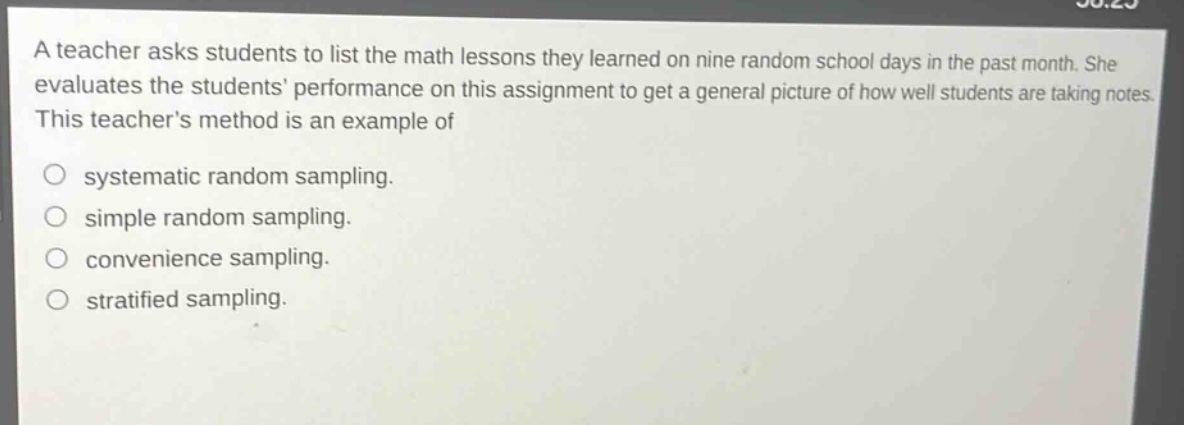
a teacher asks students to list the math lessons they learned on nine random school days in the past month. she evaluates the students performance on this assignment to get a general picture of how well students are taking notes. this teachers method is an example of\no systematic random sampling.\no simple random sampling.\no convenience sampling.\no stratified sampling.
Answer
Brief Explanations:
- Systematic random sampling: Involves selecting elements at regular intervals from an ordered population. Here, no such interval - based selection is done.
- Simple random sampling: In this case, the teacher selects nine random school days without any specific pattern or stratification. Each school day has an equal chance of being selected, which is characteristic of simple random sampling.
- Convenience sampling: Selects elements that are easily accessible. But here, it's not about convenience but random selection.
- Stratified sampling: Divides the population into subgroups (strata) and samples from each stratum. There is no indication of stratification in the teacher's method.
Answer:
simple random sampling.