you also collect demographic information about the drivers in the survey. consider the following table…
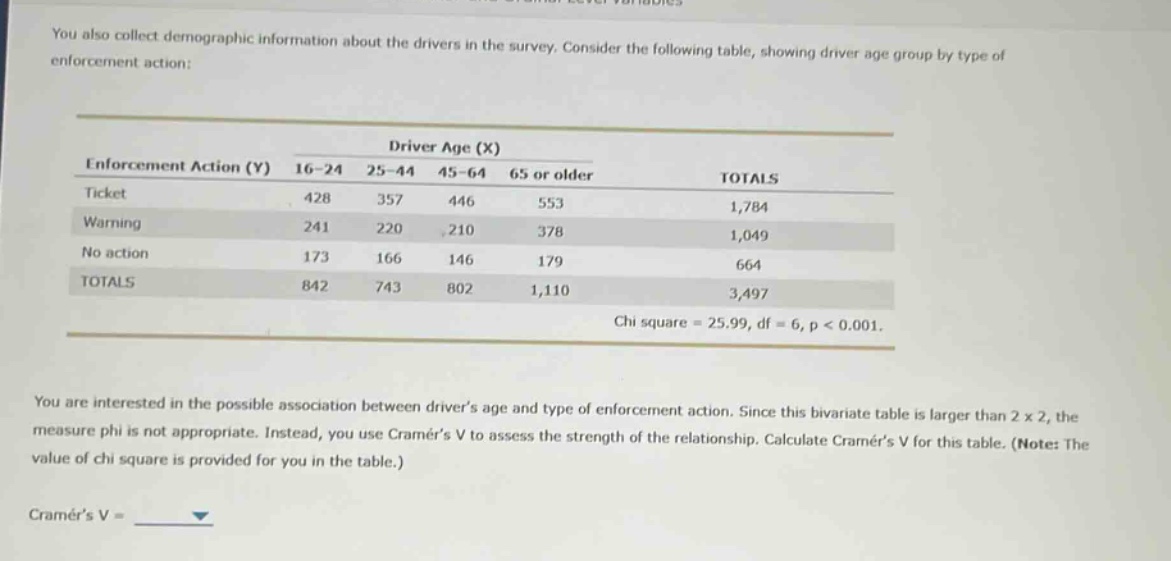
you also collect demographic information about the drivers in the survey. consider the following table, showing driver age group by type of enforcement action:\n\n| enforcement action (y) | driver age (x) | | | | totals |\n| ---- | ---- | ---- | ---- | ---- | ---- |\n| | 16 - 24 | 25 - 44 | 45 - 64 | 65 or older | |\n| ticket | 428 | 357 | 446 | 553 | 1,784 |\n| warning | 241 | 220 | 210 | 378 | 1,049 |\n| no action | 173 | 166 | 146 | 179 | 664 |\n| totals | 842 | 743 | 802 | 1,110 | 3,497 |\n\nchi square = 25.99, df = 6, p < 0.001.\n\nyou are interested in the possible association between drivers age and type of enforcement action. since this bivariate table is larger than 2 x 2, the measure phi is not appropriate. instead, you use cramérs v to assess the strength of the relationship. calculate cramérs v for this table. (note: the value of chi square is provided for you in the table.)\n\ncramérs v =
Answer
Explanation:
Step1: Recall Cramér's V formula
$V = \sqrt{\frac{\chi^{2}}{n\times(k - 1)}}$, where $\chi^{2}$ is the chi - square value, $n$ is the total sample size, and $k$ is the smaller of the number of rows or columns in the contingency table.
Step2: Identify values from the table
We are given that $\chi^{2}=25.99$, and from the table, $n = 3497$. The contingency table has 3 rows and 4 columns, so $k = 3$.
Step3: Substitute values into the formula
$V=\sqrt{\frac{25.99}{3497\times(3 - 1)}}=\sqrt{\frac{25.99}{3497\times2}}=\sqrt{\frac{25.99}{6994}}$
Step4: Calculate the value
$\frac{25.99}{6994}\approx0.003716$, and $\sqrt{0.003716}\approx0.061$
Answer:
$0.061$