10. kaycee has won a contest. to determine the amount of her prize, she must spin this spinner twice. she…
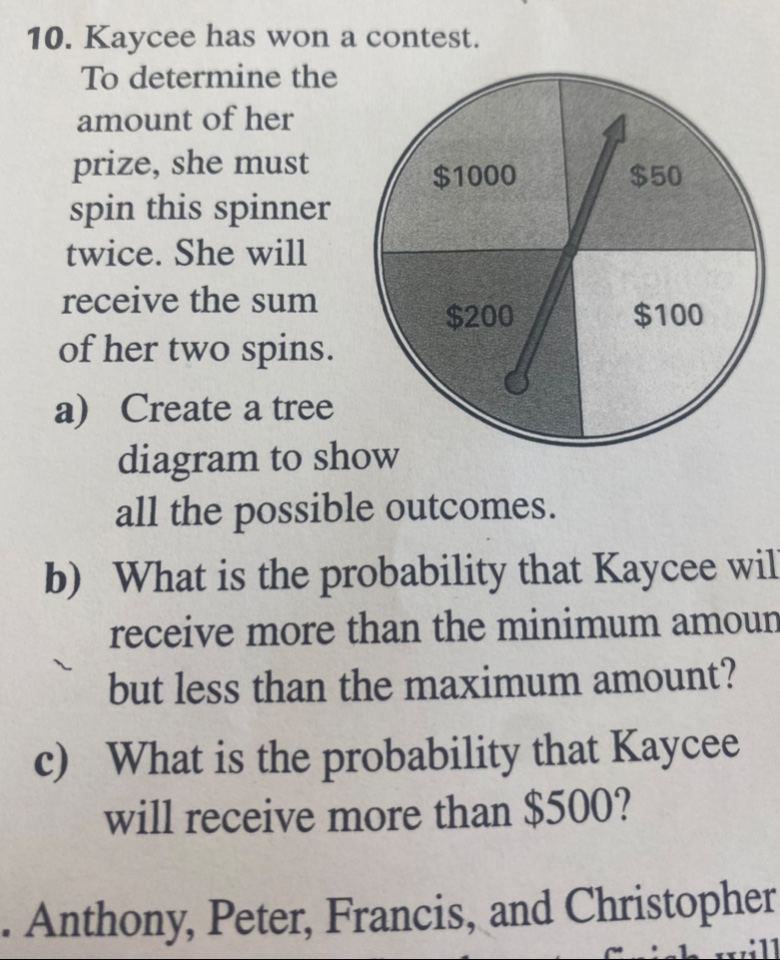
10. kaycee has won a contest. to determine the amount of her prize, she must spin this spinner twice. she will receive the sum of her two spins. a) create a tree diagram to show all the possible outcomes. b) what is the probability that kaycee will receive more than the minimum amount but less than the maximum amount? c) what is the probability that kaycee will receive more than $500?
Answer
Explanation:
Step1: Create tree - diagram for part a
The first spin has 4 possible outcomes ($50, $100, $200, $1000). For each of these outcomes, the second spin also has 4 possible outcomes. So, the tree - diagram will have 4 branches for the first spin, and from each of those branches, 4 more branches for the second spin. The total number of possible outcomes is $4\times4 = 16$. The pairs of spins and their sums are: $(50,50)=100$, $(50,100)=150$, $(50,200)=250$, $(50,1000)=1050$, $(100,50)=150$, $(100,100)=200$, $(100,200)=300$, $(100,1000)=1100$, $(200,50)=250$, $(200,100)=300$, $(200,200)=400$, $(200,1000)=1200$, $(1000,50)=1050$, $(1000,100)=1100$, $(1000,200)=1200$, $(1000,1000)=2000$.
Step2: Find minimum and maximum for part b
The minimum sum is $50 + 50=100$ and the maximum sum is $1000+1000 = 2000$. The number of outcomes that are more than 100 and less than 2000 is 14 (all except $(50,50)$ and $(1000,1000)$). The probability $P=\frac{14}{16}=\frac{7}{8}$.
Step3: Find number of outcomes greater than $500$ for part c
The pairs that give a sum greater than $500$ are: $(50,1000)$, $(100,1000)$, $(200,1000)$, $(1000,50)$, $(1000,100)$, $(1000,200)$, $(1000,1000)$. There are 7 such pairs. The probability $P=\frac{7}{16}$.
Answer:
a) Tree - diagram shows 16 possible pairs of spins and their sums as described above. b) $\frac{7}{8}$ c) $\frac{7}{16}$