11. the picture below shows a student’s coin collection. a coin is chosen at random from this collection…
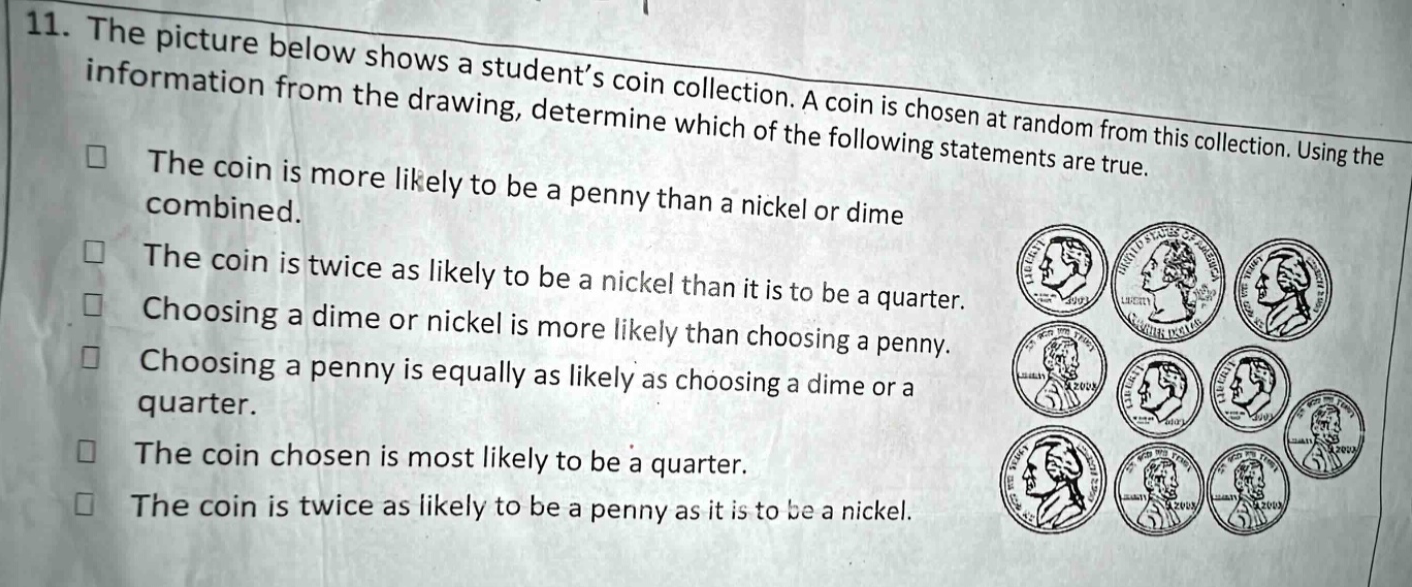
11. the picture below shows a student’s coin collection. a coin is chosen at random from this collection. using the information from the drawing, determine which of the following statements are true. the coin is more likely to be a penny than a nickel or dime combined. the coin is twice as likely to be a nickel than it is to be a quarter. choosing a dime or nickel is more likely than choosing a penny. choosing a penny is equally as likely as choosing a dime or a quarter. the coin chosen is most likely to be a quarter. the coin is twice as likely to be a penny as it is to be a nickel.
Answer
Explanation:
Step1: Count the number of each - type of coin
Let's assume the number of pennies is $p$, nickels is $n$, dimes is $d$, and quarters is $q$. From the picture, assume $p = 5$, $n = 2$, $d = 1$, $q = 3$. The total number of coins $T=p + n + d+q=5 + 2+1 + 3=11$.
Step2: Calculate the probabilities
The probability of choosing a penny $P(p)=\frac{p}{T}=\frac{5}{11}$. The probability of choosing a nickel $P(n)=\frac{n}{T}=\frac{2}{11}$. The probability of choosing a dime $P(d)=\frac{d}{T}=\frac{1}{11}$. The probability of choosing a quarter $P(q)=\frac{q}{T}=\frac{3}{11}$. The probability of choosing a nickel or a dime $P(n\ or\ d)=P(n)+P(d)=\frac{2 + 1}{11}=\frac{3}{11}$.
Step3: Analyze each statement
- "The coin is more likely to be a penny than a nickel or dime combined": Since $P(p)=\frac{5}{11}$ and $P(n\ or\ d)=\frac{3}{11}$, this statement is True.
- "The coin is twice as likely to be a nickel than it is to be a quarter": Since $P(n)=\frac{2}{11}$ and $P(q)=\frac{3}{11}$, and $\frac{2}{11}\neq2\times\frac{3}{11}$, this statement is False.
- "Choosing a dime or nickel is more likely than choosing a penny": Since $P(n\ or\ d)=\frac{3}{11}$ and $P(p)=\frac{5}{11}$, this statement is False.
- "Choosing a penny is equally as likely as choosing a dime or a quarter": Since $P(p)=\frac{5}{11}$ and $P(d\ or\ q)=P(d)+P(q)=\frac{1 + 3}{11}=\frac{4}{11}$, this statement is False.
- "The coin chosen is most likely to be a quarter": Since $P(p)=\frac{5}{11}>P(q)=\frac{3}{11}$, this statement is False.
- "The coin is twice as likely to be a penny as it is to be a nickel": Since $P(p)=\frac{5}{11}$ and $P(n)=\frac{2}{11}$, and $\frac{5}{11}\neq2\times\frac{2}{11}$, this statement is False.
Answer:
The coin is more likely to be a penny than a nickel or dime combined.