15 ablation rates for three elements in cosmic dust, by dust source\n|element|spc|ast|htc|occ|\n|----|----|…
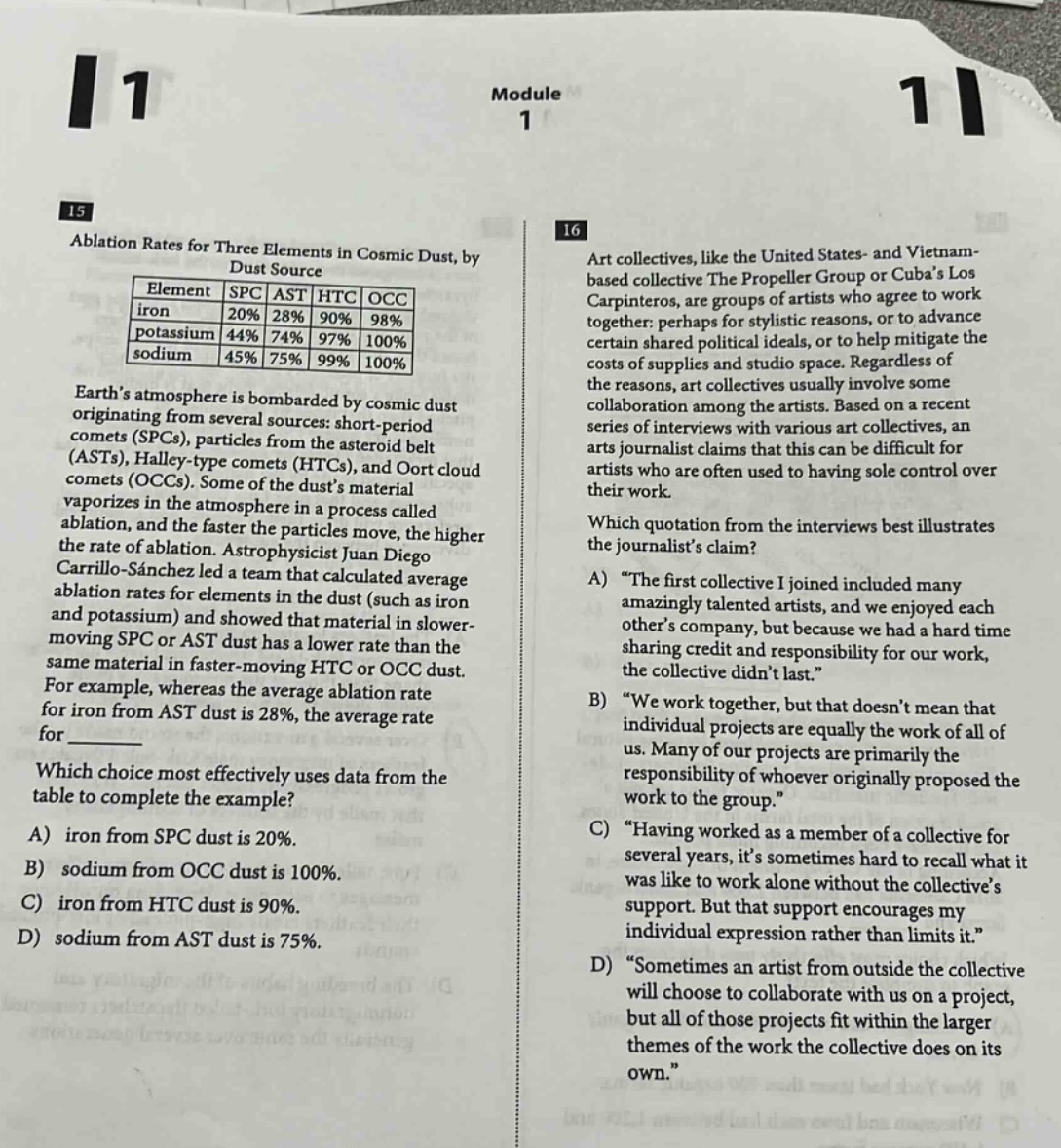
15 ablation rates for three elements in cosmic dust, by dust source\n|element|spc|ast|htc|occ|\n|----|----|----|----|----|\n|iron|20%|28%|90%|98%|\n|potassium|44%|74%|97%|100%|\n|sodium|45%|75%|99%|100%|\nearth’s atmosphere is bombarded by cosmic dust originating from several sources: short - period comets (spcs), particles from the asteroid belt (asts), halley - type comets (htcs), and oort cloud comets (occs). some of the dust’s material vaporizes in the atmosphere in a process called ablation, and the faster the particles move, the higher the rate of ablation. astrophysicist juan diego carrillo - sánchez led a team that calculated average ablation rates for elements in the dust (such as iron and potassium) and showed that a material in slower - moving spc or ast dust has a lower rate than the same material in faster - moving htc or occ dust. for example, whereas the average ablation rate for iron from ast dust is 28%, the average rate for \nwhich choice most effectively uses data from the table to complete the example?\na) iron from spc dust is 20%.\nb) sodium from occ dust is 100%.\nc) iron from htc dust is 90%.\nd) sodium from ast dust is 75%.\n16 art collectives, like the united states - and vietnam - based collective the propeller group or cuba’s los carpinteros, are groups of artists who agree to work together: perhaps for stylistic reasons, or to advance certain shared political ideals, or to help mitigate the costs of supplies and studio space. regardless of the reasons, art collectives usually involve some collaboration among the artists. based on a recent series of interviews with various art collectives, an arts journalist claims that this can be difficult for artists who are often used to having sole control over their work.\nwhich quotation from the interviews best illustrates the journalist’s claim?\na) “the first collective i joined included many amazingly talented artists, and we enjoyed each other’s company, but because we had a hard time sharing credit and responsibility for our work, the collective didn’t last.”\nb) “we work together, but that doesn’t mean that individual projects are equally the work of all of us. many of our projects are primarily the responsibility of whoever originally proposed the work to the group.”\nc) “having worked as a member of a collective for several years, it’s sometimes hard to recall what it was like to work alone without the collective’s support. but that support encourages my individual expression rather than limits it.”\nd) “sometimes an artist from outside the collective will choose to collaborate with us on a project, but all of those projects fit within the larger themes of the work the collective does on its own.”
Answer
Brief Explanations:
For the first question, we need to follow the pattern of comparing ablation - rates of iron from different dust sources as given in the example. The example starts with the ablation rate of iron from AST dust (28%), so we should choose another iron - dust source comparison. Option A provides the ablation rate of iron from SPC dust (20%), which is in line with the context. For the second question, the journalist claims that it can be difficult for artists used to sole control over their work to work in art collectives. Option A shows a problem with sharing credit and responsibility in a collective, which directly relates to the difficulty for artists used to individual control.
Answer:
- A. iron from SPC dust is 20%.
- A. “The first collective I joined included many amazingly talented artists, and we enjoyed each other’s company, but because we had a hard time sharing credit and responsibility for our work, the collective didn’t last.”