17. analyzing two - way tables you survey 83 college students and find that 65 live on campus, 31 have a car…
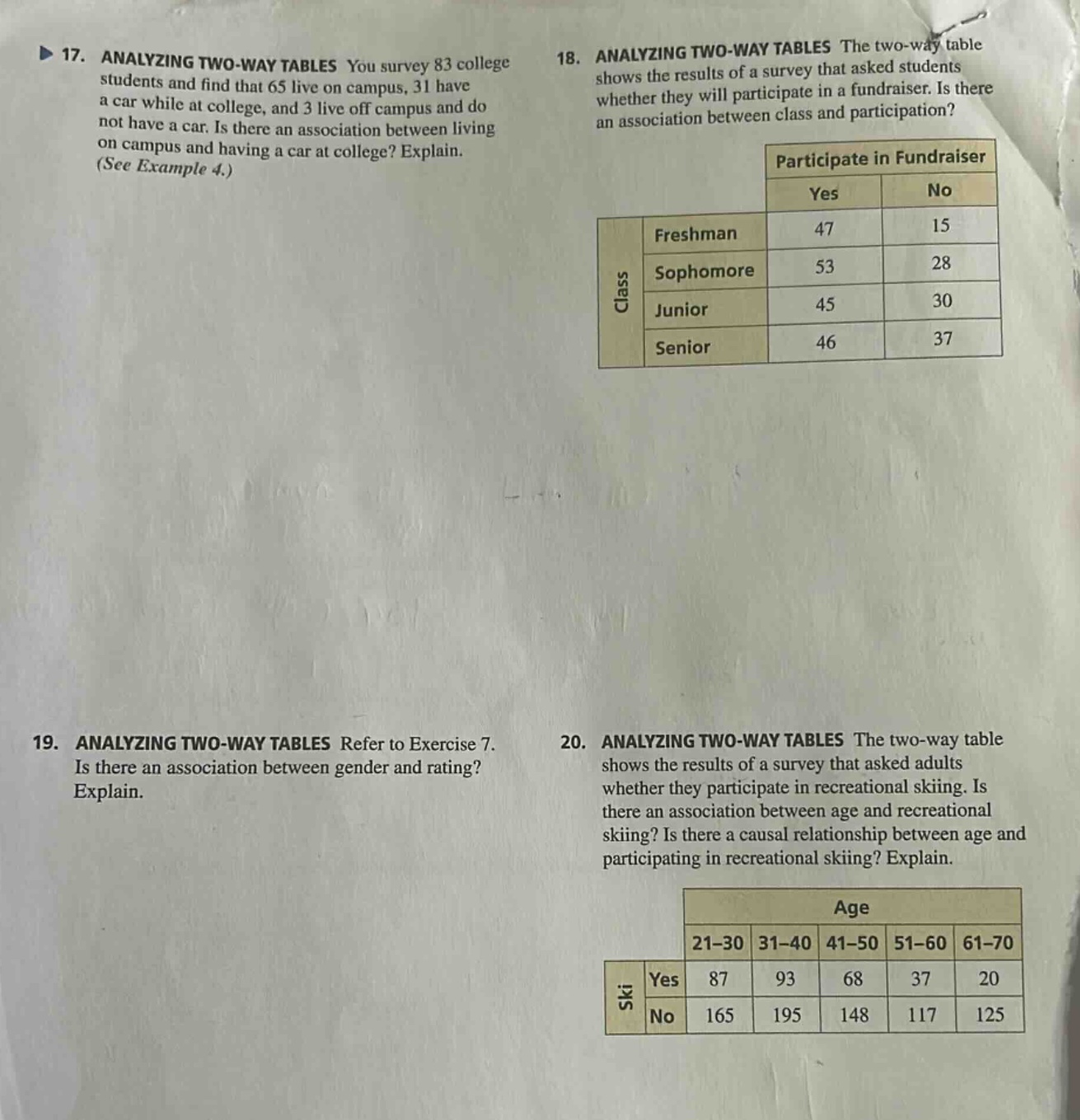
17. analyzing two - way tables you survey 83 college students and find that 65 live on campus, 31 have a car while at college, and 3 live off campus and do not have a car. is there an association between living on campus and having a car at college? explain. (see example 4.) 18. analyzing two - way tables the two - way table shows the results of a survey that asked students whether they will participate in a fundraiser. is there an association between class and participation? participate in fundraiser yes no freshman 47 15 sophomore 53 28 junior 45 30 senior 46 37 19. analyzing two - way tables refer to exercise 7. is there an association between gender and rating? explain. 20. analyzing two - way tables the two - way table shows the results of a survey that asked adults whether they participate in recreational skiing. is there an association between age and recreational skiing? is there a causal relationship between age and participating in recreational skiing? explain. age 21 - 30 31 - 40 41 - 50 51 - 60 61 - 70 ski yes 87 93 68 37 20 no 165 195 148 117 125
Answer
Explanation:
Step1: Calculate row - totals and column - totals for each table
For problem 17: Total number of students = 83. Number of students living on - campus = 65, number of students living off - campus = 83 - 65=18. Number of students with a car = 31, number of students without a car = 83 - 31 = 52. For problem 18: Row - totals for Freshman: 47 + 15=62, Sophomore: 53 + 28 = 81, Junior: 45+30 = 75, Senior: 46 + 37=83. Column - totals for Yes: 47+53 + 45+46 = 191, for No: 15 + 28+30 + 37 = 110. For problem 20: Row - totals for Yes: 87+93 + 68+37 + 20=305, for No: 165+195 + 148+117 + 125 = 750. Column - totals for 21 - 30: 87+165 = 252, 31 - 40: 93+195 = 288, 41 - 50: 68+148 = 216, 51 - 60: 37+117 = 154, 61 - 70: 20+125 = 145.
Step2: Calculate conditional probabilities
For problem 17: Let (A) be the event of living on - campus and (B) be the event of having a car. The probability of having a car given living on - campus (P(B|A)=\frac{\text{Number of on - campus students with a car}}{\text{Number of on - campus students}}). We know that the number of on - campus students is 65. Let's assume the number of on - campus students with a car is (x). We can find (x) from the information. The number of off - campus students without a car is 3. The number of students with a car is 31. Let the number of on - campus students with a car be (x), then the number of off - campus students with a car is (31 - x). The number of off - campus students is (83 - 65 = 18). So the number of off - campus students with a car is (18 - 3=15), and (x = 31 - 15 = 16). Then (P(B|A)=\frac{16}{65}\approx0.246). The probability of having a car (P(B)=\frac{31}{83}\approx0.373). Since (P(B|A)\neq P(B)), there is an association. For problem 18: For Freshman, the probability of participating (P(P|F)=\frac{47}{62}\approx0.758). For all students, the probability of participating (P(P)=\frac{191}{191 + 110}=\frac{191}{301}\approx0.635). Since (P(P|F)\neq P(P)), there is an association between class and participation. For problem 20: For the 21 - 30 age group, the probability of skiing (P(S|21 - 30)=\frac{87}{252}\approx0.345). For all ages, the probability of skiing (P(S)=\frac{305}{305 + 750}=\frac{305}{1055}\approx0.29). Since (P(S|21 - 30)\neq P(S)), there is an association between age and recreational skiing. A causal relationship is hard to determine just from the table. There could be other factors like physical ability, personal interest, etc. that influence skiing participation, not just age.
Answer:
- There is an association between living on campus and having a car.
- There is an association between class and participation.
- There is an association between age and recreational skiing. There is no clear causal relationship between age and participating in recreational skiing.