18. attention span\n\nscatter - plot showing age (years) on x - axis and time (minutes) on y - axis\n\na. no…
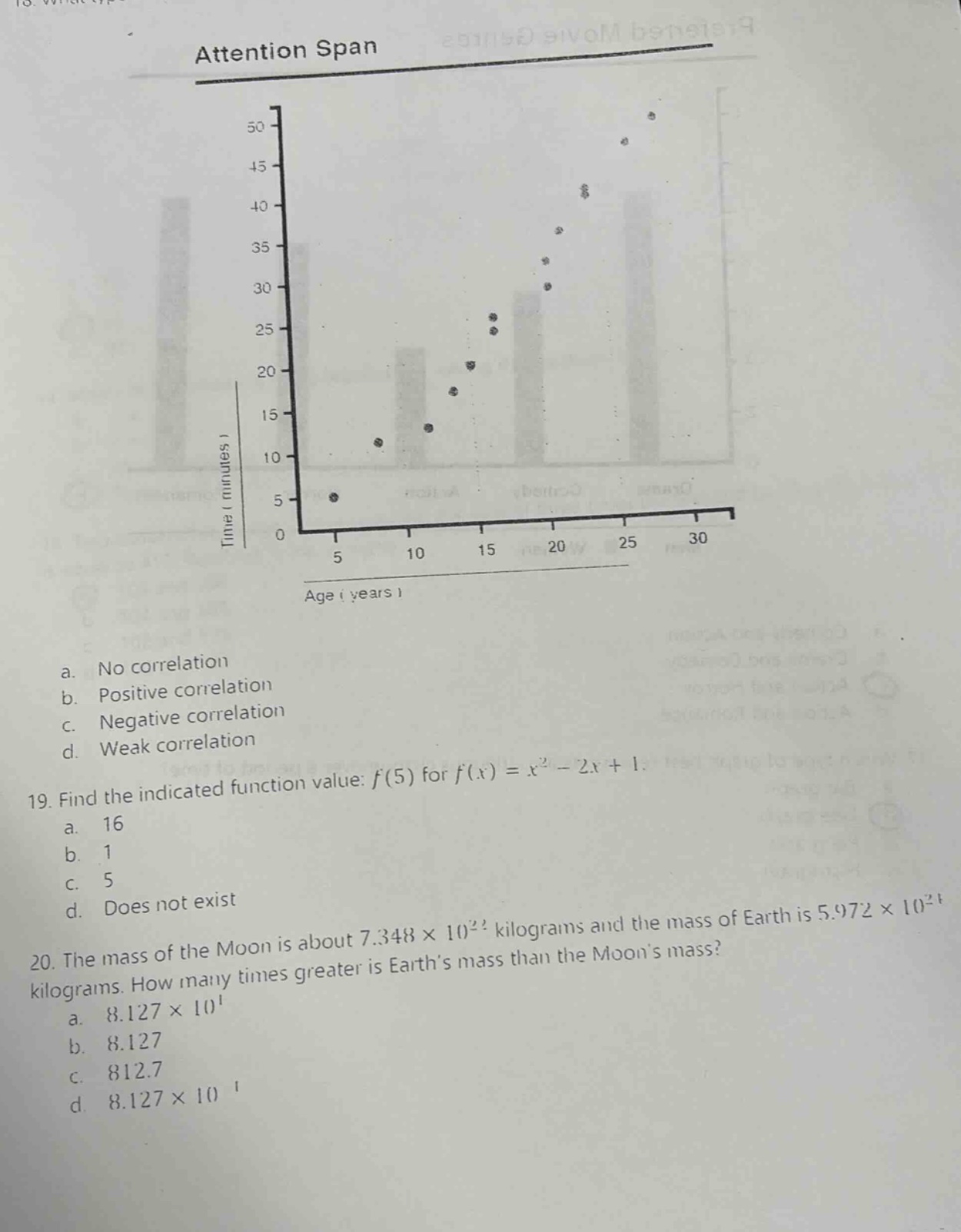
18. attention span\n\nscatter - plot showing age (years) on x - axis and time (minutes) on y - axis\n\na. no correlation\nb. positive correlation\nc. negative correlation\nd. weak correlation\n\n19. find the indicated function value: (f(5)) for (f(x)=x^{2}-2x + 1).\na. 16\nb. 1\nc. 5\nd. does not exist\n\n20. the mass of the moon is about (7.348\times10^{22}) kilograms and the mass of earth is (5.972\times10^{24}) kilograms. how many times greater is earths mass than the moons mass?\na. (8.127\times10^{1})\nb. 8.127\nc. 812.7\nd. (8.127\times10^{-1})
Answer
18.
Explanation:
Step1: Observe the scatter - plot
As age increases, the attention - span (time in minutes) generally increases.
Step2: Recall correlation types
Positive correlation means as one variable increases, the other variable also increases.
Answer:
b. Positive correlation
19.
Explanation:
Step1: Substitute (x = 5) into the function
Given (f(x)=x^{2}-2x + 1), substitute (x = 5): (f(5)=5^{2}-2\times5 + 1).
Step2: Calculate the result
[ \begin{align*} f(5)&=25-10 + 1\ &=16 \end{align*} ]
Answer:
a. 16
20.
Explanation:
Step1: Set up the ratio
To find how many times Earth's mass is greater than the Moon's mass, divide Earth's mass by the Moon's mass. Let (M_E = 5.972\times10^{24}) kg and (M_M=7.348\times10^{22}) kg. The ratio is (\frac{M_E}{M_M}=\frac{5.972\times10^{24}}{7.348\times10^{22}}).
Step2: Use exponent rules
(\frac{5.972\times10^{24}}{7.348\times10^{22}}=\frac{5.972}{7.348}\times10^{24 - 22}). (\frac{5.972}{7.348}\approx0.8127), and (10^{24 - 22}=10^{2}). So (0.8127\times10^{2}=81.27 = 8.127\times10^{1}).
Answer:
a. (8.127\times10^{1})