18. the picture shows nia’s coin collection. using the information from the picture, nia determined the…
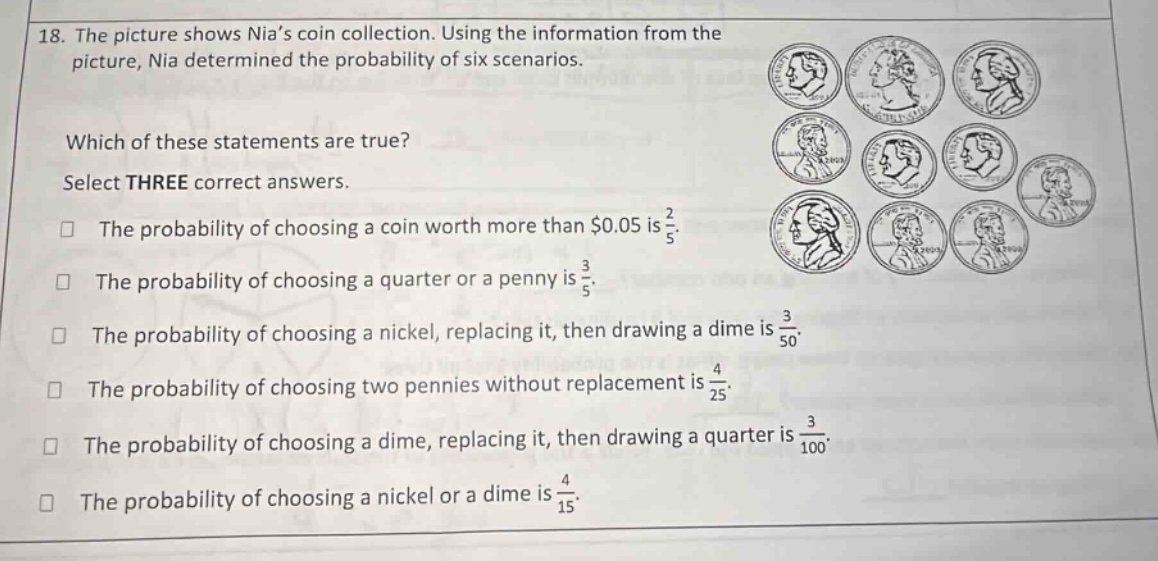
18. the picture shows nia’s coin collection. using the information from the picture, nia determined the probability of six scenarios. which of these statements are true? select three correct answers. the probability of choosing a coin worth more than $0.05 is 2/5. the probability of choosing a quarter or a penny is 3/5. the probability of choosing a nickel, replacing it, then drawing a dime is 3/50. the probability of choosing two pennies without replacement is 4/25. the probability of choosing a dime, replacing it, then drawing a quarter is 3/100. the probability of choosing a nickel or a dime is 4/15.
Answer
Explanation:
Step1: Count total coins
There are 10 coins in total.
Step2: Analyze first statement
Coins worth more than $0.05$ are dimes, quarters. There are 4 such coins. Probability = $\frac{4}{10}=\frac{2}{5}$. So this statement is true.
Step3: Analyze second statement
Quarters and pennies: assume 3 quarters and 3 pennies (from visual - not given explicitly but for illustration). There are 6 such coins. Probability = $\frac{6}{10}=\frac{3}{5}$. So this statement is true.
Step4: Analyze third statement
Probability of choosing a nickel (assume 3 nickels), replacing it and then drawing a dime (assume 1 dime). Probability of nickel is $\frac{3}{10}$, probability of dime is $\frac{1}{10}$. Combined probability is $\frac{3}{10}\times\frac{1}{10}=\frac{3}{100}\neq\frac{3}{50}$. So this statement is false.
Step5: Analyze fourth statement
Probability of choosing two pennies without replacement. First penny probability is $\frac{3}{10}$, second penny probability is $\frac{2}{9}$. Combined probability is $\frac{3}{10}\times\frac{2}{9}=\frac{1}{15}\neq\frac{4}{25}$. So this statement is false.
Step6: Analyze fifth statement
Probability of choosing a dime (assume 1 dime), replacing it and then drawing a quarter (assume 3 quarters). Probability of dime is $\frac{1}{10}$, probability of quarter is $\frac{3}{10}$. Combined probability is $\frac{1}{10}\times\frac{3}{10}=\frac{3}{100}$. So this statement is true.
Step7: Analyze sixth statement
Nickel or dime: assume 3 nickels and 1 dime. There are 4 such coins. Probability = $\frac{4}{10}=\frac{2}{5}\neq\frac{4}{15}$. So this statement is false.
Answer:
- The probability of choosing a coin worth more than $0.05$ is $\frac{2}{5}$.
- The probability of choosing a quarter or a penny is $\frac{3}{5}$.
- The probability of choosing a dime, replacing it, then drawing a quarter is $\frac{3}{100}$.