19. the origin of oxygen in earths early atmosphere was due to\na. volcanic eruptions\nb. radioactive…
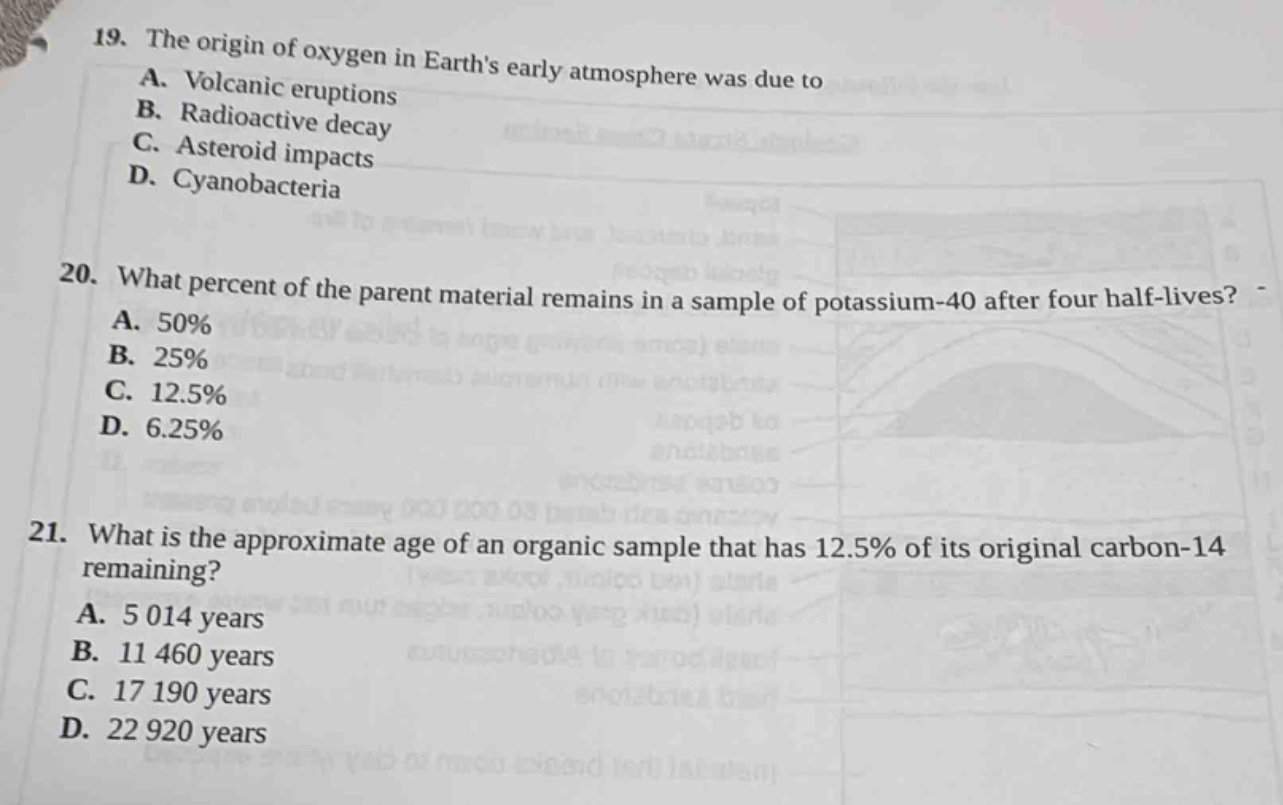
19. the origin of oxygen in earths early atmosphere was due to\na. volcanic eruptions\nb. radioactive decay\nc. asteroid impacts\nd. cyanobacteria\n\n20. what percent of the parent material remains in a sample of potassium - 40 after four half - lives?\na. 50%\nb. 25%\nc. 12.5%\nd. 6.25%\n\n21. what is the approximate age of an organic sample that has 12.5% of its original carbon - 14 remaining?\na. 5 014 years\nb. 11 460 years\nc. 17 190 years\nd. 22 920 years
Answer
Explanation:
Step1: Recall oxygen - origin knowledge
The origin of oxygen in Earth's early atmosphere was due to cyanobacteria through the process of photosynthesis. Volcanic eruptions, radioactive decay, and asteroid impacts did not contribute significantly to the oxygenation of the early atmosphere.
Step2: Recall half - life formula
The amount of parent material remaining after (n) half - lives is given by (N = N_0\times(\frac{1}{2})^n). For (n = 4), (N=\frac{N_0}{16}=0.0625N_0), which is 6.25% of the original amount.
Step3: Use half - life for carbon - 14 dating
The half - life of carbon - 14 is approximately 5730 years. If 12.5% (or (\frac{1}{8})) of the original carbon - 14 remains, and (N = N_0\times(\frac{1}{2})^n), then (\frac{1}{8}=(\frac{1}{2})^n), so (n = 3). The age of the sample is (t=3\times5730 = 17190) years.
Answer:
- D. Cyanobacteria
- D. 6.25%
- C. 17 190 years