in the 1940s, the u.s. department of commerce reported a new way to test the tensile strength, in pounds per…
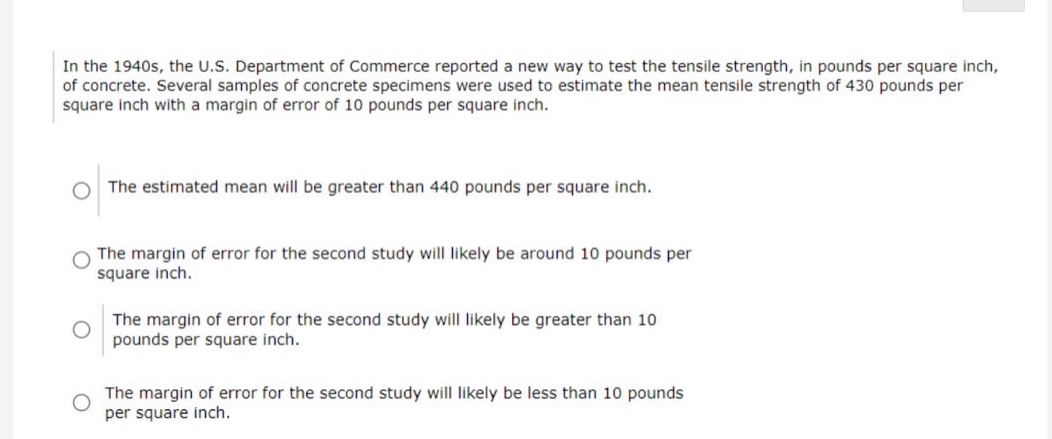
in the 1940s, the u.s. department of commerce reported a new way to test the tensile strength, in pounds per square inch, of concrete. several samples of concrete specimens were used to estimate the mean tensile strength of 430 pounds per square inch with a margin of error of 10 pounds per square inch.\nthe estimated mean will be greater than 440 pounds per square inch.\nthe margin of error for the second study will likely be around 10 pounds per square inch.\nthe margin of error for the second study will likely be greater than 10 pounds per square inch.\nthe margin of error for the second study will likely be less than 10 pounds per square inch.
Answer
Explanation:
Step1: Analyze given information
The first - study estimated mean tensile strength is 430 pounds per square inch with a margin of error of 10 pounds per square inch. There is no information about the second - study sample size, sampling method etc. So, we cannot make a definite conclusion about the margin of error of the second study.
Step2: Evaluate each option
- Option 1: The estimated mean of 430 pounds per square inch with a margin of error of 10 pounds per square inch means the true mean is in the interval ((430 - 10,430 + 10)=(420,440)). So, it is incorrect to say the estimated mean will be greater than 440 pounds per square inch.
- Option 2: Since there is no information about the second - study, we cannot say for sure that the margin of error for the second study will be around 10 pounds per square inch.
- Option 3: Similarly, we cannot say that the margin of error for the second study will be greater than 10 pounds per square inch without more information about the second - study.
- Option 4: Also, we cannot say that the margin of error for the second study will be less than 10 pounds per square inch without more information about the second - study. But based on the lack of information, we cannot rule out any of these margin - of - error possibilities for the second study. However, if we assume that the second study has similar characteristics (sample size, sampling method etc.) to the first study, the most reasonable assumption is that the margin of error will be around the same value as in the first study.
Answer:
There is not enough information to determine the answer.