the 2010 general social survey asked a large number of people how much time they spent watching tv each day…
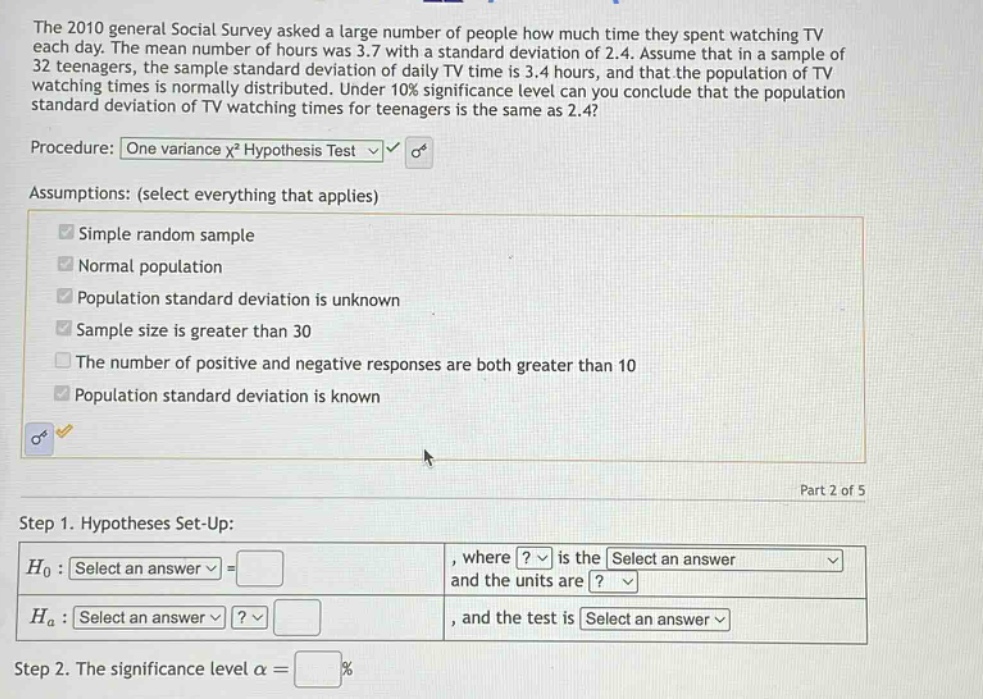
the 2010 general social survey asked a large number of people how much time they spent watching tv each day. the mean number of hours was 3.7 with a standard deviation of 2.4. assume that in a sample of 32 teenagers, the sample standard deviation of daily tv time is 3.4 hours, and that the population of tv watching times is normally distributed. under 10% significance level can you conclude that the population standard deviation of tv watching times for teenagers is the same as 2.4?\nprocedure: one variance $chi^{2}$ hypothesis test\nassumptions: (select everything that applies)\nsimple random sample\nnormal population\npopulation standard deviation is unknown\nsample size is greater than 30\nthe number of positive and negative responses are both greater than 10\npopulation standard deviation is known\npart 2 of 5\nstep 1. hypotheses set - up:\n$h_{0}$: select an answer = \n, where? is the select an answer and the units are?\n$h_{a}$: select an answer? \n, and the test is select an answer\nstep 2. the significance level $alpha=$ %
Answer
Explanation:
Step1: Identify the null and alternative hypotheses for a one - variance $\chi^{2}$ test
The null hypothesis $H_0$ is that the population variance $\sigma^{2}$ is equal to the hypothesized variance. The hypothesized standard deviation is $\sigma_0 = 2.4$, so the hypothesized variance is $\sigma_0^{2}=(2.4)^{2}=5.76$. So $H_0:\sigma^{2}=5.76$, where $\sigma^{2}$ is the population variance and the units are hours$^{2}$. The alternative hypothesis $H_a$ for a two - tailed test (since we are just testing if the variance is the same or not) is $H_a:\sigma^{2}\neq5.76$.
Step2: Determine the significance level
The significance level $\alpha$ is given as 10% or 0.10.
Answer:
$H_0:\sigma^{2}=5.76$, where $\sigma^{2}$ is the population variance and the units are hours$^{2}$ $H_a:\sigma^{2}\neq5.76$, and the test is two - tailed $\alpha = 10$%