only 25% of pickles contain the winning phrase. if we buy 20 pickles, how can we design a simulation to find…
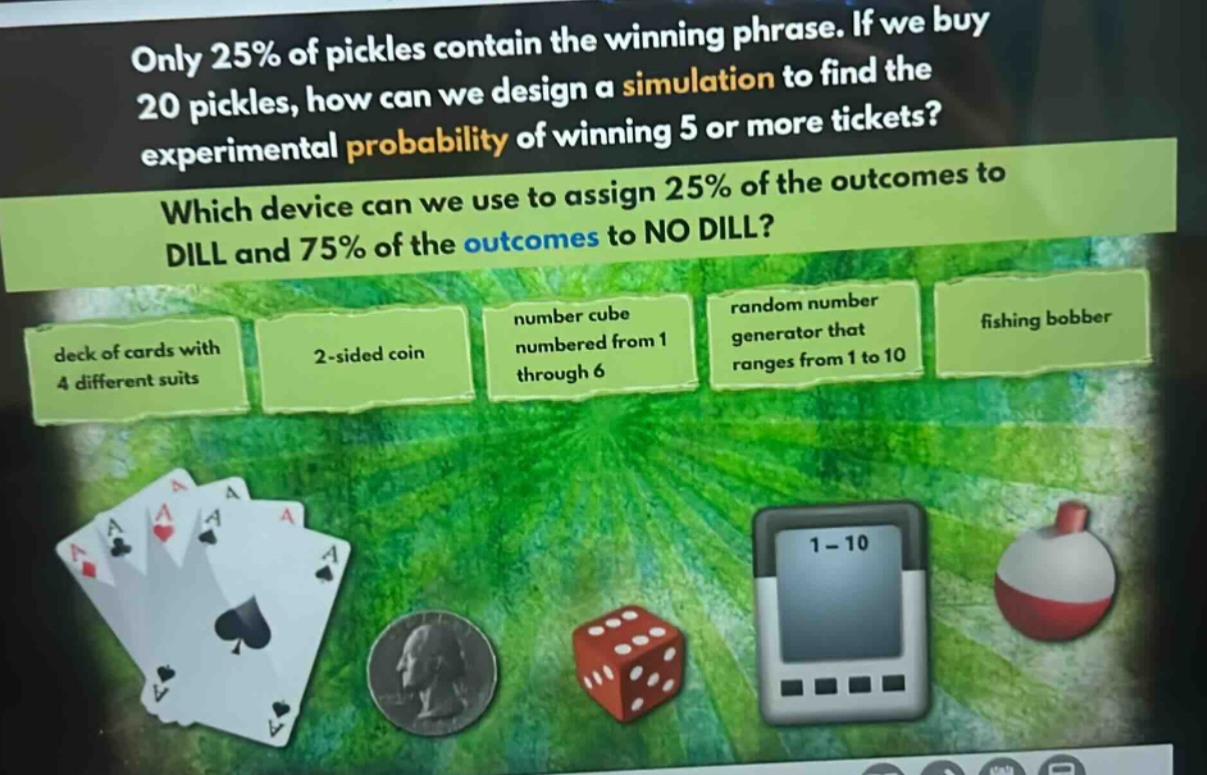
only 25% of pickles contain the winning phrase. if we buy 20 pickles, how can we design a simulation to find the experimental probability of winning 5 or more tickets? which device can we use to assign 25% of the outcomes to dill and 75% of the outcomes to no dill? deck of cards with 4 different suits 2 - sided coin number cube numbered from 1 through 6 random number generator that ranges from 1 to 10 fishing bobber
Answer
Explanation:
Step1: Analyze each device
- Deck of cards: There are 4 suits. We can assign 1 suit (1 out of 4, which is $\frac{1}{4}=25%$) to DILL and 3 suits (3 out of 4, which is $\frac{3}{4} = 75%$) to NO DILL.
- 2 - sided coin: It has 2 outcomes, and we can't divide the outcomes to get 25% and 75% exactly.
- Number cube: It has 6 outcomes. We can't divide 6 to get 25% and 75% of the outcomes exactly.
- Random number generator from 1 - 10: We can assign numbers 1 - 2 (2 out of 10, which is $\frac{2}{10}=20%$) to DILL and numbers 3 - 10 (8 out of 10, which is $\frac{8}{10}=80%$) to NO DILL, not the required 25% and 75%.
- Fishing bobber: There is no clear way to divide its outcomes into 25% and 75%.
Answer:
deck of cards with 4 different suits