35 an insurance agent is looking at records to determine if there is a relationship between a drivers age…
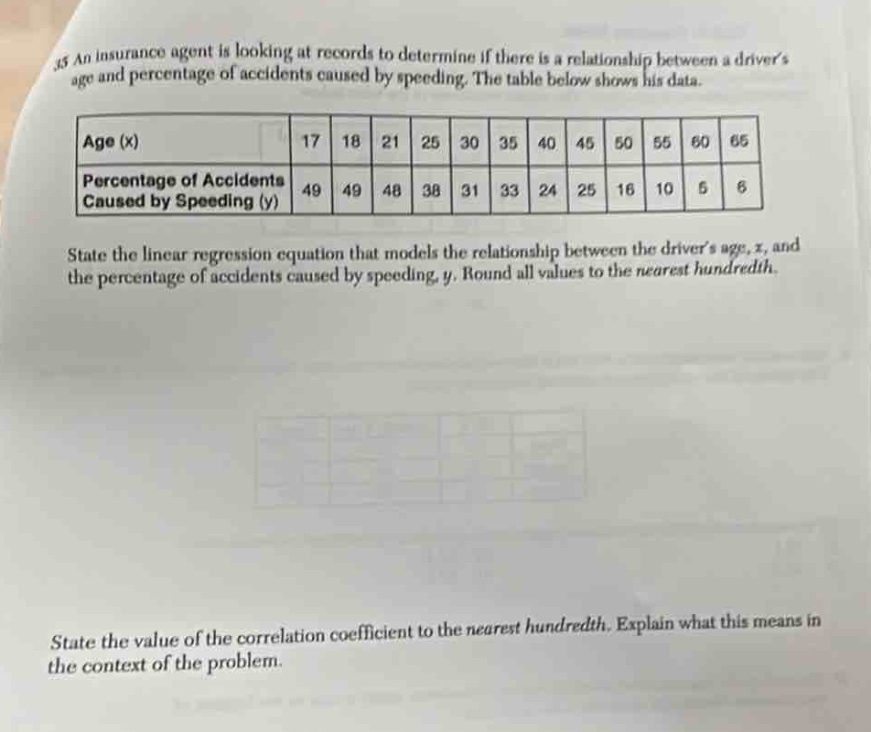
35 an insurance agent is looking at records to determine if there is a relationship between a drivers age and percentage of accidents caused by speeding. the table below shows his data.\n| age (x) | 17 | 18 | 21 | 25 | 30 | 35 | 40 | 45 | 50 | 55 | 60 | 65 |\n| percentage of accidents caused by speeding (y) | 49 | 49 | 48 | 38 | 31 | 33 | 24 | 25 | 16 | 10 | 5 | 6 |\nstate the linear - regression equation that models the relationship between the drivers age, x, and the percentage of accidents caused by speeding, y. round all values to the nearest hundredth.\nstate the value of the correlation coefficient to the nearest hundredth. explain what this means in the context of the problem.
Answer
Explanation:
Step1: Calculate necessary sums
Let (n = 12) (number of data - points). Calculate (\sum x), (\sum y), (\sum x^{2}), (\sum y^{2}), (\sum xy). (\sum x=17 + 18+21+25+30+35+40+45+50+55+60+65 = 461) (\sum y=49 + 49+48+38+31+33+24+25+16+10+5+6 = 344) (\sum x^{2}=17^{2}+18^{2}+21^{2}+25^{2}+30^{2}+35^{2}+40^{2}+45^{2}+50^{2}+55^{2}+60^{2}+65^{2}) (=289 + 324+441+625+900+1225+1600+2025+2500+3025+3600+4225 = 20809) (\sum y^{2}=49^{2}+49^{2}+48^{2}+38^{2}+31^{2}+33^{2}+24^{2}+25^{2}+16^{2}+10^{2}+5^{2}+6^{2}) (=2401+2401+2304+1444+961+1089+576+625+256+100+25+36 = 12118) (\sum xy=(17\times49)+(18\times49)+(21\times48)+(25\times38)+(30\times31)+(35\times33)+(40\times24)+(45\times25)+(50\times16)+(55\times10)+(60\times5)+(65\times6)) (=833+882+1008+950+930+1155+960+1125+800+550+300+390 = 9983)
Step2: Calculate the slope (m)
The formula for the slope (m) of the regression - line is (m=\frac{n\sum xy-\sum x\sum y}{n\sum x^{2}-(\sum x)^{2}}) (m=\frac{12\times9983 - 461\times344}{12\times20809-461^{2}}) (=\frac{119796-158584}{249708 - 212521}=\frac{-38788}{37187}\approx - 1.04)
Step3: Calculate the y - intercept (b)
The formula for the y - intercept (b) is (b=\overline{y}-m\overline{x}), where (\overline{x}=\frac{\sum x}{n}=\frac{461}{12}\approx38.42) and (\overline{y}=\frac{\sum y}{n}=\frac{344}{12}\approx28.67) (b = 28.67-(-1.04)\times38.42) (=28.67 + 1.04\times38.42=28.67+39.96 = 68.63)
The linear regression equation is (y=-1.04x + 68.63)
Step4: Calculate the correlation coefficient (r)
The formula for the correlation coefficient (r) is (r=\frac{n\sum xy-\sum x\sum y}{\sqrt{(n\sum x^{2}-(\sum x)^{2})(n\sum y^{2}-(\sum y)^{2})}}) (r=\frac{12\times9983 - 461\times344}{\sqrt{(12\times20809 - 461^{2})(12\times12118-344^{2})}}) (=\frac{-38788}{\sqrt{37187\times12118\times12 - 344^{2}\times37187}}) (=\frac{-38788}{\sqrt{37187\times(145416 - 118336)}}) (=\frac{-38788}{\sqrt{37187\times27080}}) (=\frac{-38788}{\sqrt{1007033960}}) (=\frac{-38788}{31734.05}\approx - 0.97)
The correlation coefficient (r\approx - 0.97). A correlation coefficient close to (-1) indicates a strong negative linear relationship. In the context of this problem, it means that as the age of the driver increases, the percentage of accidents caused by speeding decreases significantly.
Answer:
The linear regression equation is (y=-1.04x + 68.63). The correlation coefficient is (r\approx - 0.97), which indicates a strong negative linear relationship between the driver's age and the percentage of accidents caused by speeding.