41. drawing conclusions you invest $2500 in an account to save for college. account 1 pays 6% annual…
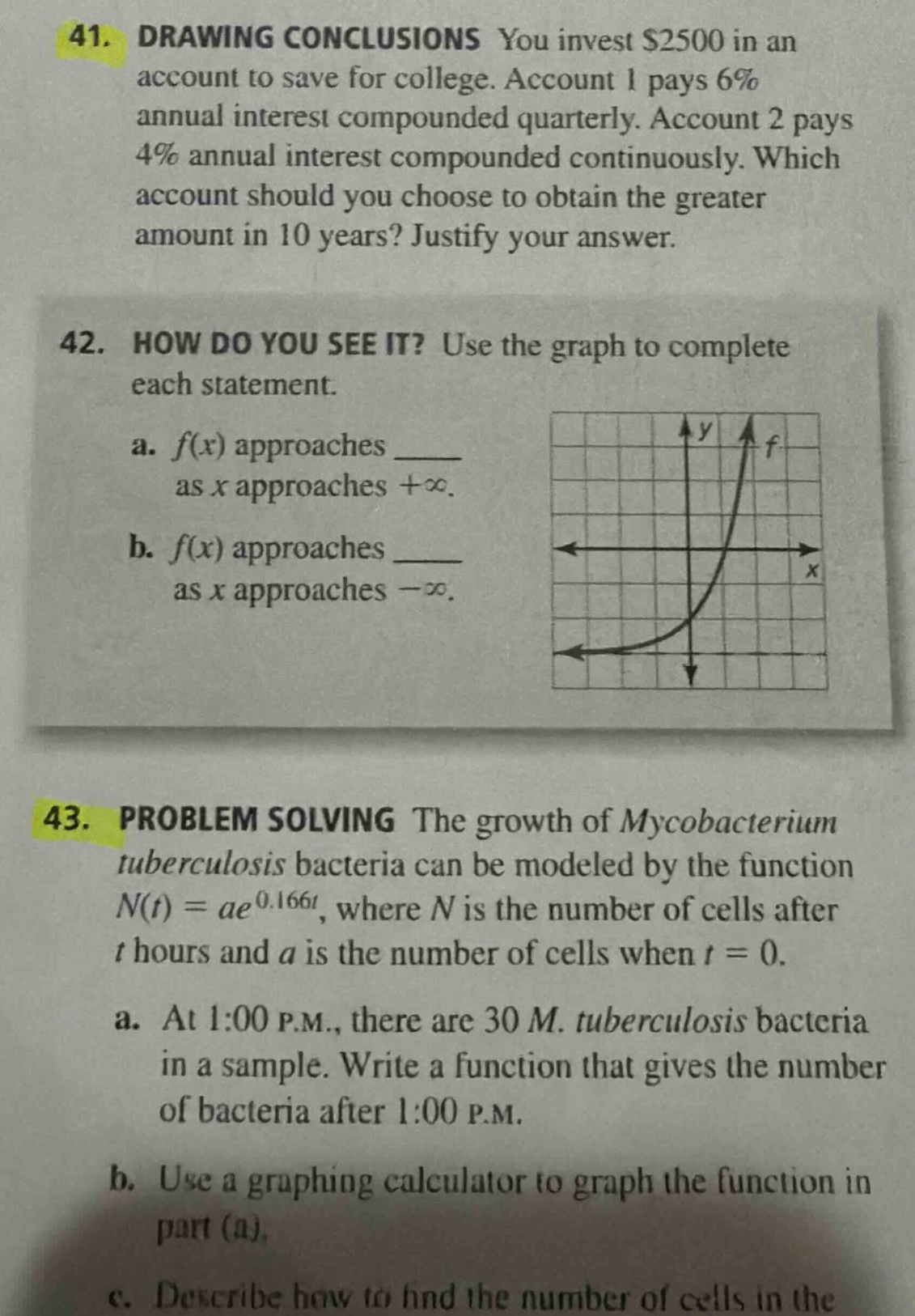
41. drawing conclusions you invest $2500 in an account to save for college. account 1 pays 6% annual interest compounded quarterly. account 2 pays 4% annual interest compounded continuously. which account should you choose to obtain the greater amount in 10 years? justify your answer.\n42. how do you see it? use the graph to complete each statement.\na. $f(x)$ approaches ___ as $x$ approaches $+infty$.\nb. $f(x)$ approaches ___ as $x$ approaches $-infty$.\n43. problem solving the growth of mycobacterium tuberculosis bacteria can be modeled by the function $n(t)=ae^{0.166t}$, where $n$ is the number of cells after $t$ hours and $a$ is the number of cells when $t = 0$.\na. at 1:00 p.m., there are 30 m. tuberculosis bacteria in a sample. write a function that gives the number of bacteria after 1:00 p.m.\nb. use a graphing calculator to graph the function in part (a).\nc. describe how to find the number of cells in the
Answer
41.
Explanation:
Step1: Use compound - interest formula for Account 1
The compound - interest formula is $A = P(1+\frac{r}{n})^{nt}$, where $P=$2500$, $r = 0.06$, $n = 4$ (quarterly compounding), and $t = 10$. $A_1=2500(1 +\frac{0.06}{4})^{4\times10}=2500(1 + 0.015)^{40}=2500\times1.015^{40}$. Calculate $1.015^{40}\approx1.818$. Then $A_1=2500\times1.818=$4545$.
Step2: Use continuous - compounding formula for Account 2
The continuous - compounding formula is $A=Pe^{rt}$, where $P = 2500$, $r=0.04$, and $t = 10$. $A_2=2500e^{0.04\times10}=2500e^{0.4}$. Since $e^{0.4}\approx1.492$, then $A_2=2500\times1.492=$3730$.
Step3: Compare the two amounts
Since $A_1 = 4545$ and $A_2=3730$, and $4545>3730$.
Answer:
You should choose Account 1 because it will yield a greater amount ($$4545$) compared to Account 2 ($$3730$) in 10 years.
42.
Explanation:
Step1: Analyze the graph as $x\to+\infty$
Looking at the graph, as $x$ approaches positive infinity, the function $y = f(x)$ goes up without bound. So $f(x)$ approaches $+\infty$.
Step2: Analyze the graph as $x\to-\infty$
As $x$ approaches negative infinity, the function $y = f(x)$ approaches a horizontal asymptote. The value of the horizontal asymptote is $y = 0$. So $f(x)$ approaches $0$.
Answer:
a. $+\infty$ b. $0$
43.
Explanation:
Step1: Write the function for part a
Given $N(t)=ae^{0.166t}$ and $a = 30$ (since at $t = 0$ (1:00 P.M.), there are 30 bacteria), the function is $N(t)=30e^{0.166t}$.
Step2: For part b
To graph $N(t)=30e^{0.166t}$ on a graphing calculator, enter the function $y = 30e^{0.166x}$ (where $x$ represents $t$). Set an appropriate window for $x$ (e.g., $x\geq0$) and $y$ (starting from $y = 0$ and going up to a reasonable value based on the growth of the exponential function).
Step3: For part c
To find the number of cells at a specific time $t$, substitute the value of $t$ into the function $N(t)=30e^{0.166t}$ and calculate the result using a calculator. For example, if $t = 5$, then $N(5)=30e^{0.166\times5}=30e^{0.83}$. Calculate $e^{0.83}\approx2.293$ and $N(5)=30\times2.293 = 68.79\approx69$ cells.
Answer:
a. $N(t)=30e^{0.166t}$ b. Enter $y = 30e^{0.166x}$ into a graphing calculator and set an appropriate window. c. Substitute the value of $t$ into $N(t)=30e^{0.166t}$ and calculate.