56. the table below shows some of the properties of the elements cobalt and nickel. properties of cobalt and…
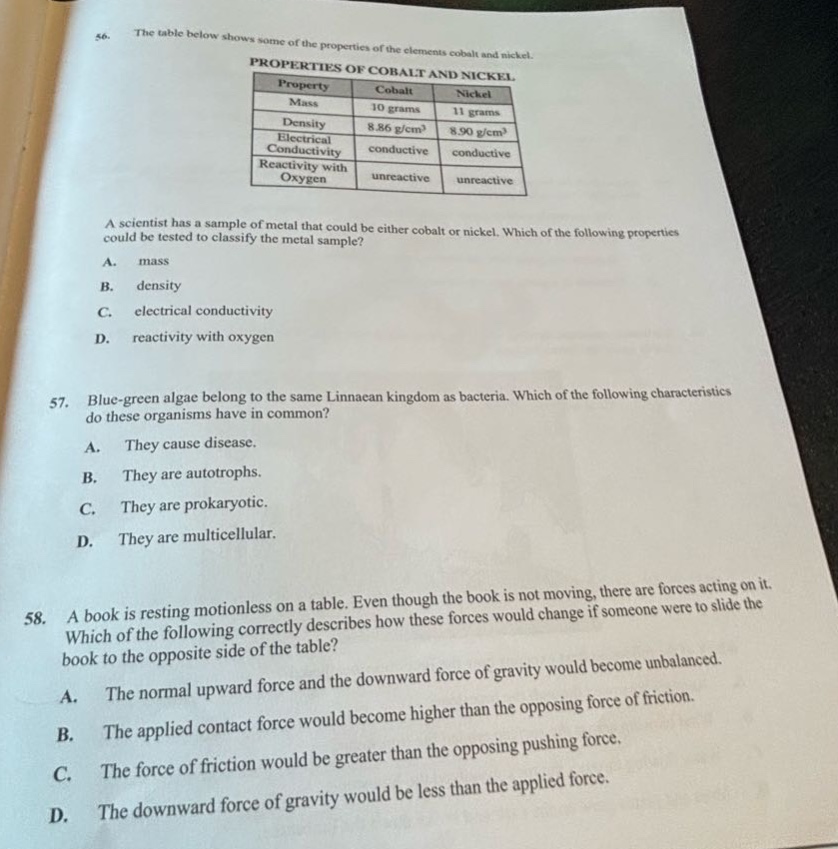
56. the table below shows some of the properties of the elements cobalt and nickel. properties of cobalt and nickel property cobalt nickel mass 10 grams 11 grams density 8.86 g/cm³ 8.90 g/cm³ electrical conductivity conductive conductive reactivity with oxygen unreactive unreactive a scientist has a sample of metal that could be either cobalt or nickel. which of the following properties could be tested to classify the metal sample? a. mass b. density c. electrical conductivity d. reactivity with oxygen 57. blue - green algae belong to the same linnaean kingdom as bacteria. which of the following characteristics do these organisms have in common? a. they cause disease. b. they are autotrophs. c. they are prokaryotic. d. they are multicellular. 58. a book is resting motionless on a table. even though the book is not moving, there are forces acting on it. which of the following correctly describes how these forces would change if someone were to slide the book to the opposite side of the table? a. the normal upward force and the downward force of gravity would become unbalanced. b. the applied contact force would become higher than the opposing force of friction. c. the force of friction would be greater than the opposing pushing force. d. the downward force of gravity would be less than the applied force.
Answer
56.
Brief Explanations:
Mass can vary depending on sample size. Electrical conductivity and reactivity with oxygen are the same for both. Density is a characteristic property and different for cobalt and nickel, useful for identification.
Answer:
B. density
57.
Brief Explanations:
Blue - green algae (cyanobacteria) and bacteria are prokaryotes. Not all cause disease, not all are autotrophs, and they are mostly unicellular.
Answer:
C. They are prokaryotic.
58.
Brief Explanations:
To slide the book, an applied contact force must overcome the frictional force. Gravity remains constant and normal force is perpendicular to motion.
Answer:
B. The applied contact force would become higher than the opposing force of friction.