according to historical data, it is believed that 12% of american adults work more than one job. to see if…
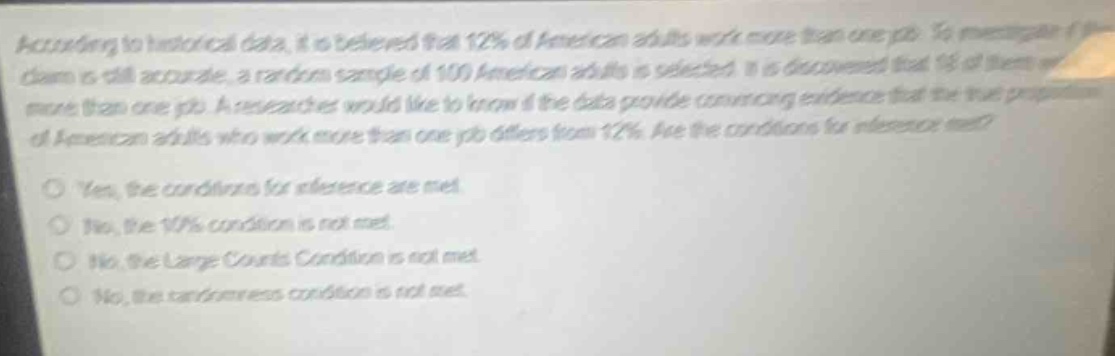
according to historical data, it is believed that 12% of american adults work more than one job. to see if this claim is still accurate, a random sample of 100 american adults is selected. it is discovered that 15 of them work more than one job. a researcher would like to know if the data provide convincing evidence that the true proportion of american adults who work more than one job differs from 12%. are the conditions for inference met?\n\nyes, the conditions for inference are met.\nno, the 10% condition is not met.\nno, the large counts condition is not met.\nno, the randomness condition is not met.
Answer
Explanation:
Step1: Check randomness
The sample is a random sample of 100 American adults, so the randomness condition is met.
Step2: Check 10% condition
There are far more than 1000 American adults (since the population of American adults is in the millions), so the 10% condition ($n\leq0.1N$) is met.
Step3: Check Large - Counts condition
Let $p = 0.12$ (the hypothesized proportion) and $n=100$. Calculate $np = 100\times0.12=12$ and $n(1 - p)=100\times(1 - 0.12)=88$. Since $np\geq10$ and $n(1 - p)\geq10$, the Large - Counts condition is met.
Answer:
Yes, the conditions for inference are met.