according to a recent survey of adults, approximately 62% carry cash on a regular basis. the adults were…
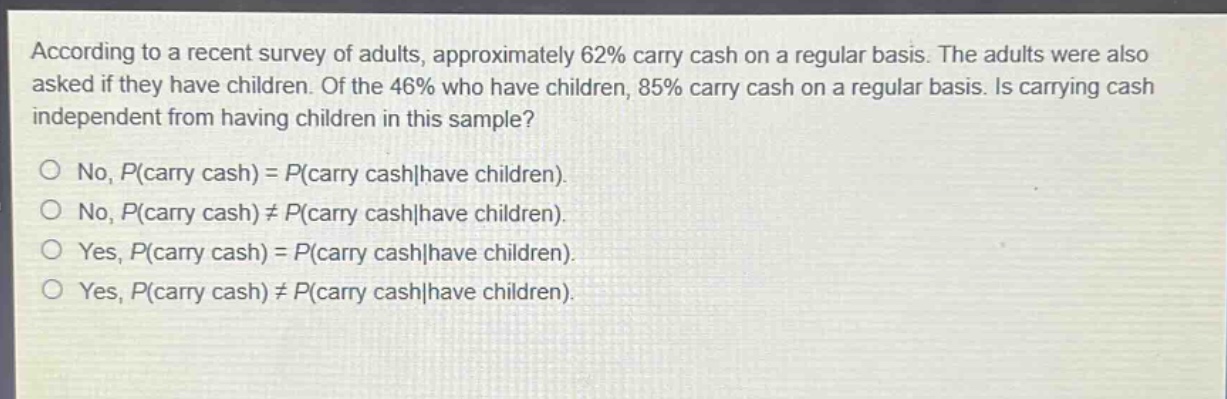
according to a recent survey of adults, approximately 62% carry cash on a regular basis. the adults were also asked if they have children. of the 46% who have children, 85% carry cash on a regular basis. is carrying cash independent from having children in this sample?\nno, p(carry cash) = p(carry cash|have children).\nno, p(carry cash) ≠ p(carry cash|have children).\nyes, p(carry cash) = p(carry cash|have children).\nyes, p(carry cash) ≠ p(carry cash|have children).
Answer
Explanation:
Step1: Identify given probabilities
We are given that $P(\text{carry cash}) = 0.62$. Also, $P(\text{have children})=0.46$ and $P(\text{carry cash}|\text{have children}) = 0.85$.
Step2: Recall independence condition
Two events $A$ and $B$ are independent if $P(A)=P(A|B)$. Here, $A$ is the event of carrying cash and $B$ is the event of having children.
Step3: Compare probabilities
Since $0.62\neq0.85$, i.e., $P(\text{carry cash})\neq P(\text{carry cash}|\text{have children})$, the events are not independent.
Answer:
No, $P(\text{carry cash})\neq P(\text{carry cash}|\text{have children})$.