according to a survey, 10% of americans are afraid to fly. suppose 1,100 americans are sampled.\na. what is…
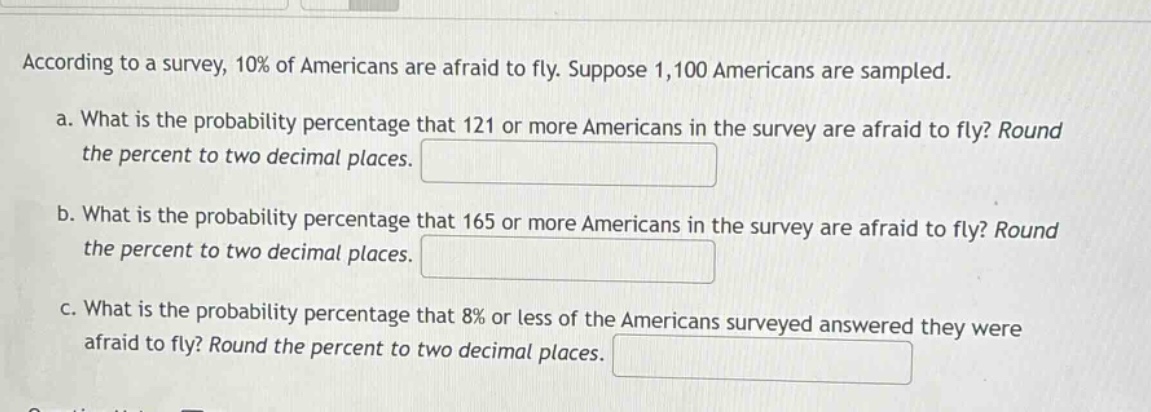
according to a survey, 10% of americans are afraid to fly. suppose 1,100 americans are sampled.\na. what is the probability percentage that 121 or more americans in the survey are afraid to fly? round the percent to two decimal places.\nb. what is the probability percentage that 165 or more americans in the survey are afraid to fly? round the percent to two decimal places.\nc. what is the probability percentage that 8% or less of the americans surveyed answered they were afraid to fly? round the percent to two decimal places.
Answer
Explanation:
Step1: Identify distribution parameters
This is a binomial - to - normal approximation problem. Let (n = 1100) (sample size) and (p=0.1). The mean of the binomial distribution is (\mu = np=1100\times0.1 = 110), and the standard deviation is (\sigma=\sqrt{np(1 - p)}=\sqrt{1100\times0.1\times(1 - 0.1)}=\sqrt{1100\times0.1\times0.9}=\sqrt{99}\approx9.95).
Step2: Standardize for part a
For (x = 121), the z - score is (z=\frac{x-\mu}{\sigma}=\frac{121 - 110}{9.95}=\frac{11}{9.95}\approx1.11). We want (P(X\geq121)), which is equivalent to (P(Z\geq1.11)) in the normal - approximation. Using the standard normal table, (P(Z\geq1.11)=1 - P(Z < 1.11)=1 - 0.8665 = 0.1335), or (13.35%).
Step3: Standardize for part b
For (x = 165), the z - score is (z=\frac{x-\mu}{\sigma}=\frac{165 - 110}{9.95}=\frac{55}{9.95}\approx5.53). We want (P(X\geq165)), which is equivalent to (P(Z\geq5.53)) in the normal - approximation. Since the standard normal table typically only goes up to (z = 3.49), and for (z\geq3.49), (P(Z\geq z)\approx0). So (P(Z\geq5.53)\approx0.00%).
Step4: Standardize for part c
The number of Americans in the sample corresponding to (8%) is (x = 0.08\times1100 = 88). The z - score is (z=\frac{x-\mu}{\sigma}=\frac{88 - 110}{9.95}=\frac{- 22}{9.95}\approx - 2.21). We want (P(X\leq88)), which is equivalent to (P(Z\leq - 2.21)) in the normal - approximation. Using the standard normal table, (P(Z\leq - 2.21)=0.0136), or (1.36%).
Answer:
a. (13.35%) b. (0.00%) c. (1.36%)