according to a survey, 15% of city workers take the bus to work. donatella randomly surveys 10 workers. what…
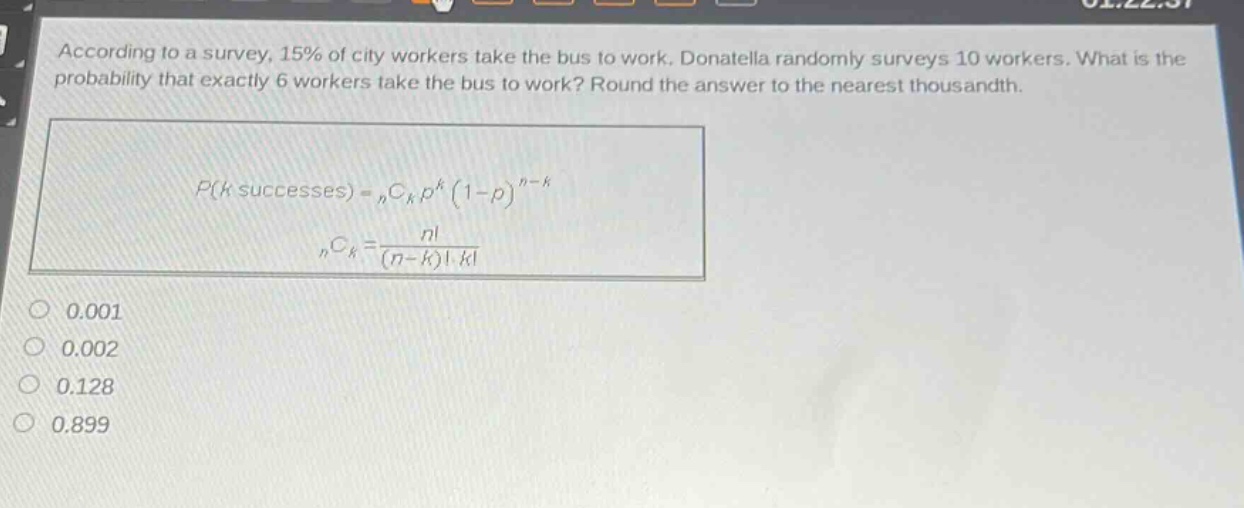
according to a survey, 15% of city workers take the bus to work. donatella randomly surveys 10 workers. what is the probability that exactly 6 workers take the bus to work? round the answer to the nearest thousandth.\n\n$p(k\text{ successes}) = _nc_kp^k(1 - p)^{n - k}$\n\n$_nc_k=\frac{n!}{(n - k)!k!}$\n\n0.001\n0.002\n0.128\n0.899
Answer
Explanation:
Step1: Identify values of n, k, p
n = 10 (number of workers surveyed), k = 6 (number of workers taking bus), p = 0.15 (probability a worker takes bus)
Step2: Calculate combination ({n}C{k})
[{n}C{k}=\frac{n!}{(n - k)!k!}=\frac{10!}{(10 - 6)!6!}=\frac{10\times9\times8\times7\times6!}{4\times3\times2\times1\times6!}=210]
Step3: Calculate (p^{k}(1 - p)^{n - k})
[p^{k}(1 - p)^{n - k}=(0.15)^{6}(1 - 0.15)^{10 - 6}=(0.15)^{6}(0.85)^{4}] [ (0.15)^{6}=0.000011390625] [ (0.85)^{4}=0.52200625] [ (0.15)^{6}(0.85)^{4}=0.000011390625\times0.52200625\approx0.00000594]
Step4: Calculate (P(k))
[P(6)={n}C{k}p^{k}(1 - p)^{n - k}=210\times0.00000594\approx0.001]
Answer:
0.001