across: 1) subjects are assigned to different treatment groups through a process of random selection 2)…
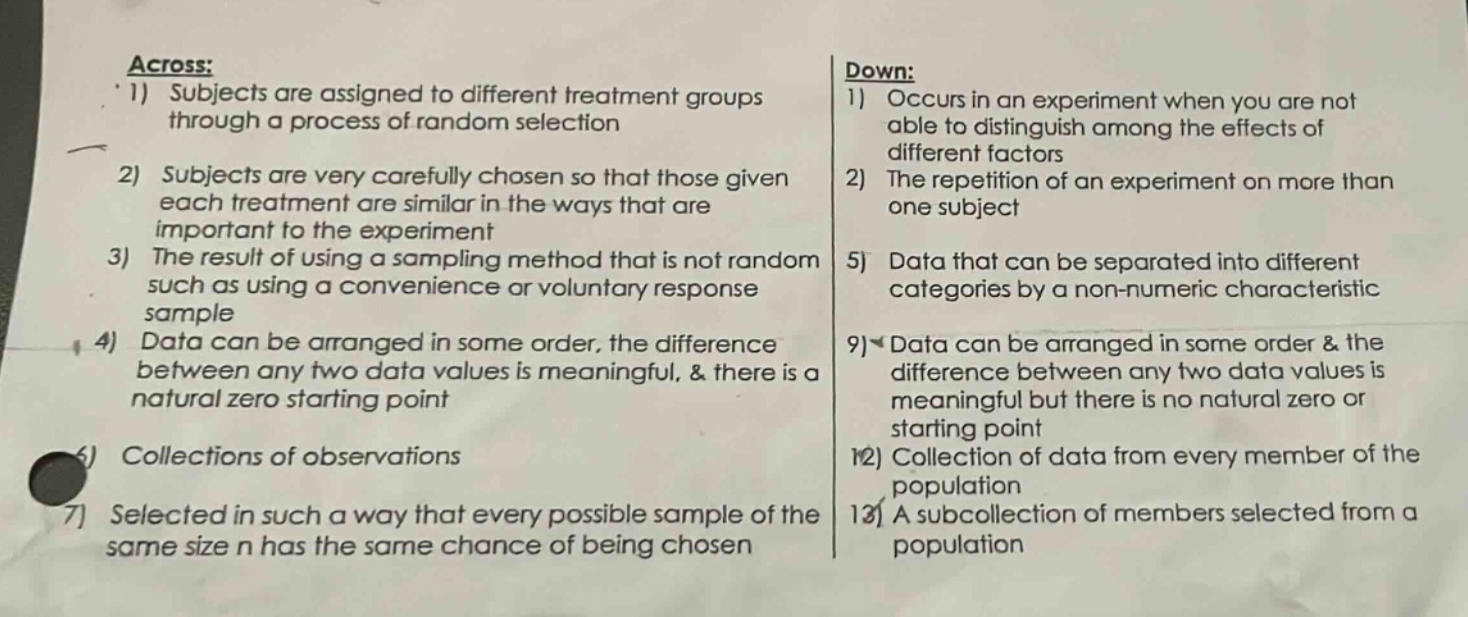
across: 1) subjects are assigned to different treatment groups through a process of random selection 2) subjects are very carefully chosen so that those given each treatment are similar in the ways that are important to the experiment 3) the result of using a sampling method that is not random such as using a convenience or voluntary response sample 4) data can be arranged in some order, the difference between any two data values is meaningful, & there is a natural zero starting point 6) collections of observations 7) selected in such a way that every possible sample of the same size n has the same chance of being chosen down: 1) occurs in an experiment when you are not able to distinguish among the effects of different factors 2) the repetition of an experiment on more than one subject 5) data that can be separated into different categories by a non - numeric characteristic 9) data can be arranged in some order & the difference between any two data values is meaningful but there is no natural zero or starting point 12) collection of data from every member of the population 13) a subcollection of members selected from a population
Answer
Brief Explanations:
- Across 1: This describes random assignment in experiments, a key concept in statistics for ensuring unbiased results.
- Across 2: This is the concept of matching in experimental design, where subjects are carefully selected for similarity.
- Across 3: Non - random sampling methods like convenience or voluntary response sampling lead to bias in data collection.
- Across 4: This is the definition of ratio - level data in statistics, which has a natural zero and meaningful differences between values.
- Across 6: Collections of observations are called data sets in statistics.
- Across 7: This is the definition of a simple random sample in statistics.
- Down 1: This is the concept of confounding in experiments, where the effects of different factors cannot be distinguished.
- Down 2: Repeating an experiment on more than one subject is replication in experimental design.
- Down 5: Data that can be separated into categories by a non - numeric characteristic is categorical data in statistics.
- Down 9: This is the definition of interval - level data in statistics, which has meaningful differences but no natural zero.
- Down 12: Collecting data from every member of the population is a census in statistics.
- Down 13: A sub - collection of members selected from a population is a sample in statistics.
Answer:
- Across 1: Random Assignment
- Across 2: Matching
- Across 3: Bias
- Across 4: Ratio Data
- Across 6: Data
- Across 7: Simple Random Sample
- Down 1: Confounding
- Down 2: Replication
- Down 5: Categorical Data
- Down 9: Interval Data
- Down 12: Census
- Down 13: Sample