the ages of the people in attendance at the showing of an award - winning foreign film are shown below…
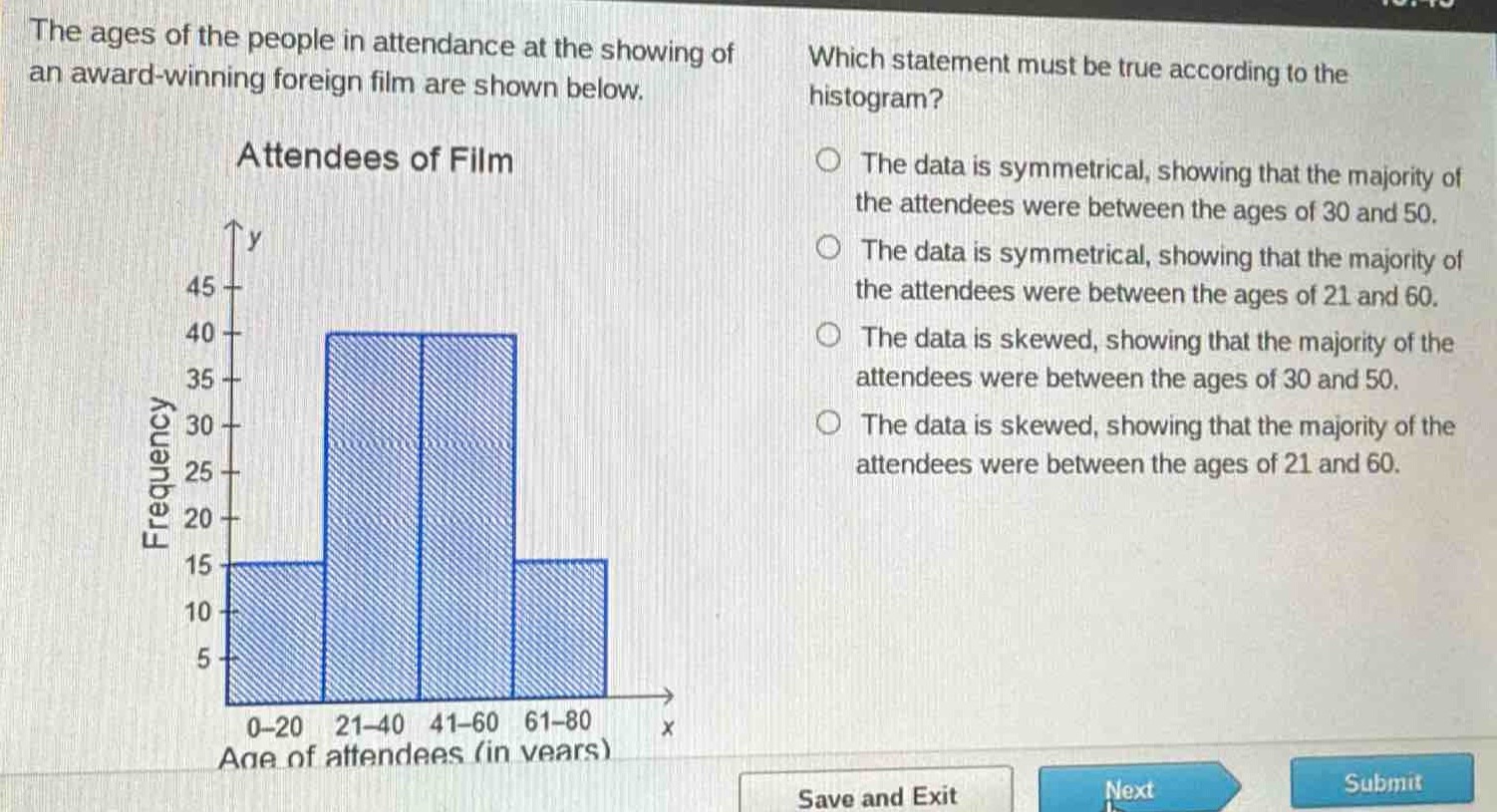
the ages of the people in attendance at the showing of an award - winning foreign film are shown below. which statement must be true according to the histogram? attendees of film frequency age of attendees (in years) 0 - 20 21 - 40 41 - 60 61 - 80 the data is symmetrical, showing that the majority of the attendees were between the ages of 30 and 50. the data is symmetrical, showing that the majority of the attendees were between the ages of 21 and 60. the data is skewed, showing that the majority of the attendees were between the ages of 30 and 50. the data is skewed, showing that the majority of the attendees were between the ages of 21 and 60.
Answer
Explanation:
Step1: Analyze data symmetry
The histogram is not symmetric as the left - hand side and right - hand side do not mirror each other.
Step2: Identify peak frequency interval
The highest frequency bars are in the 21 - 40 and 41 - 60 age intervals. So the majority of attendees are in the 21 - 60 age range.
Step3: Check for skewness
Since the data is not symmetric, it is skewed.
Answer:
The data is skewed, showing that the majority of the attendees were between the ages of 21 and 60.