aiden read that blue jays can mimic the calls of other birds like hawks and crows. he wanted to listen to…
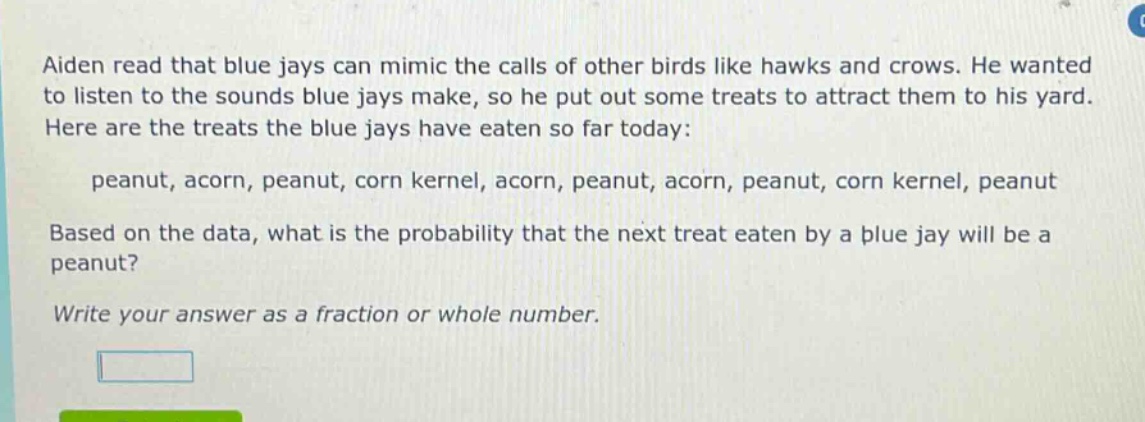
aiden read that blue jays can mimic the calls of other birds like hawks and crows. he wanted to listen to the sounds blue jays make, so he put out some treats to attract them to his yard. here are the treats the blue jays have eaten so far today: peanut, acorn, peanut, corn kernel, acorn, peanut, acorn, peanut, corn kernel, peanut based on the data, what is the probability that the next treat eaten by a blue jay will be a peanut? write your answer as a fraction or whole number.
Answer
Explanation:
Step1: Count total treats
There are 10 treats in total (peanut, acorn, peanut, corn kernel, acorn, peanut, acorn, peanut, corn kernel, peanut).
Step2: Count peanut treats
There are 6 peanut treats.
Step3: Calculate probability
The probability $P$ of an event is the number of favorable outcomes divided by the total number of outcomes. So $P=\frac{\text{number of peanuts}}{\text{total number of treats}}=\frac{6}{10}=\frac{3}{5}$.
Answer:
$\frac{3}{5}$