alejandro surveyed his classmates to determine who has ever gone surfing and who has ever gone snowboarding…
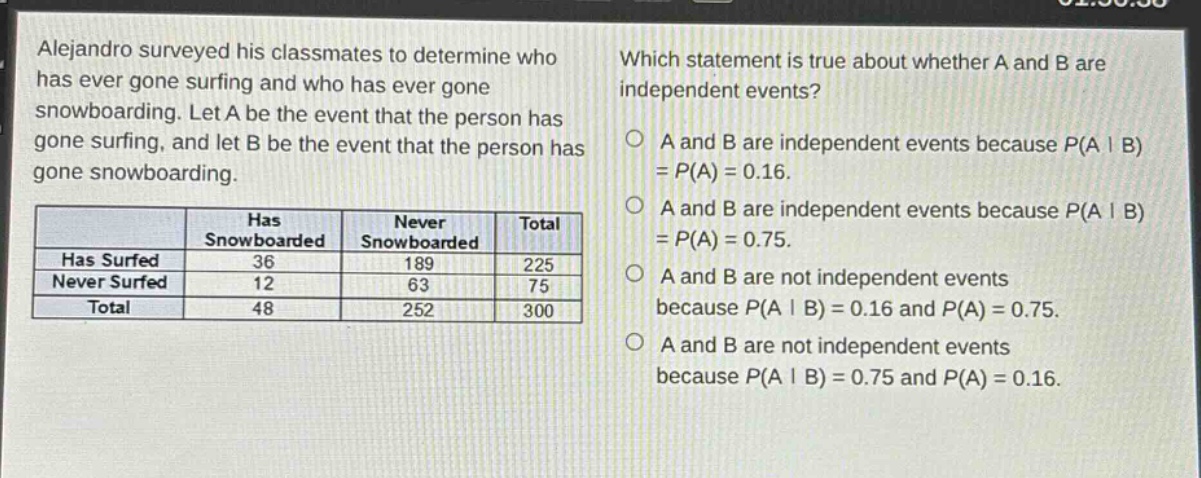
alejandro surveyed his classmates to determine who has ever gone surfing and who has ever gone snowboarding. let a be the event that the person has gone surfing, and let b be the event that the person has gone snowboarding.\n| | has snowboarded | never snowboarded | total |\n|--|--|--|--|\n| has surfed | 36 | 189 | 225 |\n| never surfed | 12 | 63 | 75 |\n| total | 48 | 252 | 300 |\nwhich statement is true about whether a and b are independent events?\na and b are independent events because p(a | b)=p(a)=0.16.\na and b are independent events because p(a | b)=p(a)=0.75.\na and b are not independent events because p(a | b)=0.16 and p(a)=0.75.\na and b are not independent events because p(a | b)=0.75 and p(a)=0.16.
Answer
Answer:
C. A and B are not independent events because (P(A|B)=0.75) and (P(A) = 0.16).
Explanation:
Step1: Calculate (P(A))
The probability (P(A)) (person has gone surfing) is the number of people who have surfed divided by the total number of people surveyed. There are 225 people who have surfed out of 300 total people. So (P(A)=\frac{225}{300}=0.75).
Step2: Calculate (P(A|B))
The probability (P(A|B)) (person has surfed given they have snow - boarded) is calculated using the formula (P(A|B)=\frac{P(A\cap B)}{P(B)}). (P(A\cap B)=\frac{36}{300}) and (P(B)=\frac{48}{300}). Then (P(A|B)=\frac{\frac{36}{300}}{\frac{48}{300}}=\frac{36}{48} = 0.75).
Step3: Check independence
Two events (A) and (B) are independent if (P(A|B)=P(A)). Here, (P(A|B) = 0.75) and (P(A)=0.16), since (P(A|B)\neq P(A)), (A) and (B) are not independent events.