alejandro wants to determine the average shoe size of all of the male students in his school. which sample…
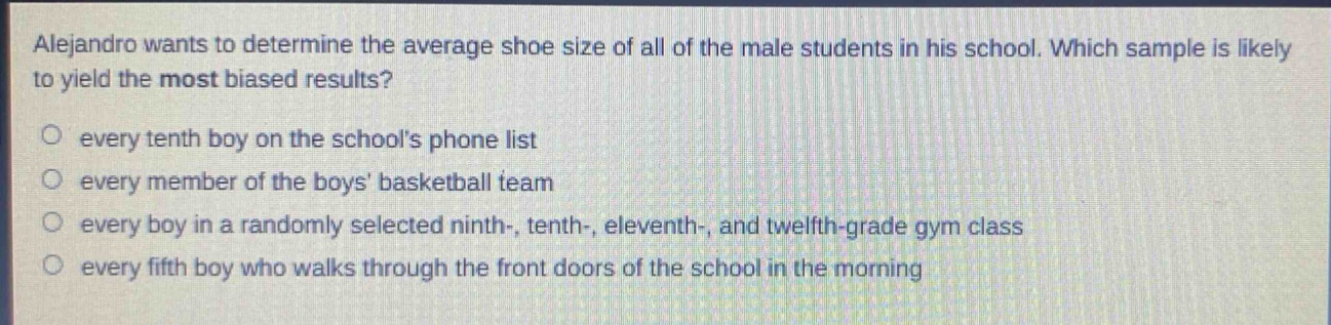
alejandro wants to determine the average shoe size of all of the male students in his school. which sample is likely to yield the most biased results?\no every tenth boy on the schools phone list\no every member of the boys basketball team\no every boy in a randomly selected ninth-, tenth-, eleventh-, and twelfth - grade gym class\no every fifth boy who walks through the front doors of the school in the morning
Answer
Answer:
B. every member of the boys' basketball team
Explanation:
Step1: Analyze sampling bias concept
Sampling bias occurs when a sample is not representative of the population.
Step2: Evaluate each option
- Option A: Selecting every tenth boy on the school's phone list is a form of systematic - sampling and can be relatively random for male students in school.
- Option B: Boys' basketball team members are likely to have larger shoe sizes on average compared to all male students in school as taller and larger - footed students may be more likely to play basketball. This sample is not representative of all male students' shoe sizes, causing bias.
- Option C: Selecting boys from randomly - selected gym classes in different grades can give a diverse sample of male students in terms of physical characteristics including shoe size.
- Option D: Selecting every fifth boy walking through the front doors in the morning can be a form of random sampling for male students arriving at school and is likely to be more representative than the basketball team sample.