alicia surveys 31 people about how many world languages they speak. she finds that 11 people speak spanish…
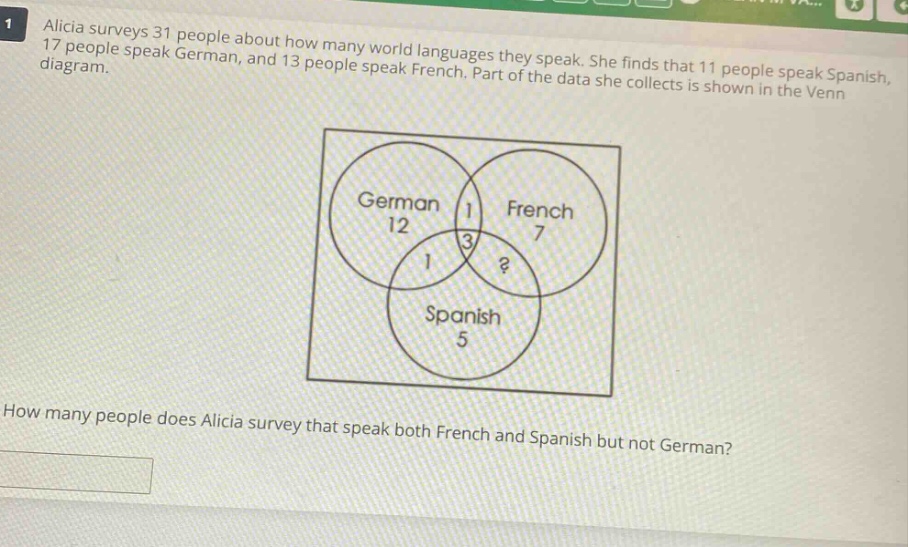
alicia surveys 31 people about how many world languages they speak. she finds that 11 people speak spanish, 17 people speak german, and 13 people speak french. part of the data she collects is shown in the venn diagram. how many people does alicia survey that speak both french and spanish but not german?
Answer
Explanation:
Step1: Recall the principle of Venn - diagram
Let (G) be the set of German - speakers, (F) be the set of French - speakers and (S) be the set of Spanish - speakers. We know (n(G\cup F\cup S)=31), (n(G) = 17), (n(F)=13), (n(S)=11).
Step2: Use the formula for the number of elements in the union of three sets
(n(G\cup F\cup S)=n(G)+n(F)+n(S)-n(G\cap F)-n(G\cap S)-n(F\cap S)+n(G\cap F\cap S)). From the Venn - diagram, (n(G) = 12 + 1+1 + 3=17), (n(F)=1 + 3+7+\text{x}), (n(S)=1 + 3+5+\text{x}), and (n(G\cap F\cap S)=3), (n(G\cap F)=1 + 3), (n(G\cap S)=1 + 3).
Step3: Calculate the unknown value
We know that the sum of all the regions in the Venn - diagram should equal the total number of people surveyed ((31)). Let the number of people who speak French and Spanish but not German be (x). The sum of the regions in the Venn - diagram is (12+1 + 1+3+7+x + 5=31). Combining like terms gives (29 + x=31). Subtracting 29 from both sides: (x=31 - 29=2).
Answer:
2