analyzing two data sets\namber and chloe recorded the number of minutes they spent studying for ten days…
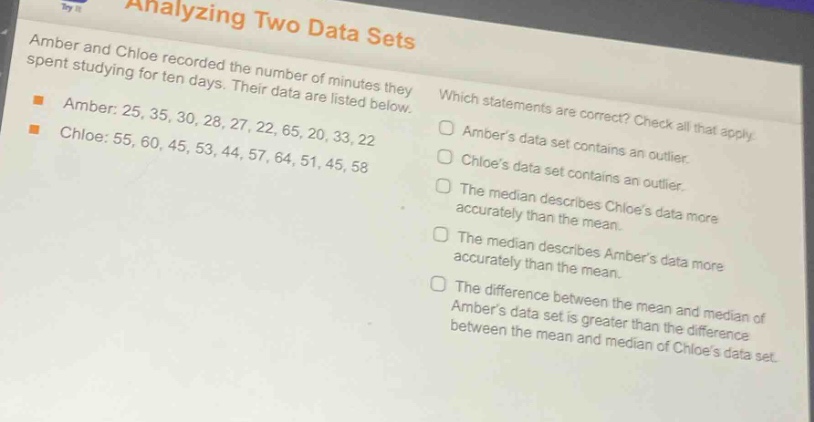
analyzing two data sets\namber and chloe recorded the number of minutes they spent studying for ten days. their data are listed below.\namber: 25, 35, 30, 28, 27, 22, 65, 20, 33, 22\nchloe: 55, 60, 45, 53, 44, 57, 64, 51, 45, 58\nwhich statements are correct? check all that apply.\nambers data set contains an outlier.\nchloes data set contains an outlier.\nthe median describes chloes data more accurately than the mean.\nthe median describes ambers data more accurately than the mean.\nthe difference between the mean and median of ambers data set is greater than the difference between the mean and median of chloes data set.
Answer
Explanation:
Step1: Sort Amber's data
$20,22,22,25,27,28,30,33,35,65$
Step2: Calculate Amber's median
Since $n = 10$ (even), median is $\frac{27 + 28}{2}=27.5$
Step3: Calculate Amber's mean
$\frac{20 + 22+22+25+27+28+30+33+35+65}{10}=\frac{317}{10} = 31.7$
Step4: Sort Chloe's data
$44,45,45,51,53,55,57,58,60,64$
Step5: Calculate Chloe's median
Since $n = 10$ (even), median is $\frac{53+55}{2}=54$
Step6: Calculate Chloe's mean
$\frac{44 + 45+45+51+53+55+57+58+60+64}{10}=\frac{532}{10}=53.2$
Step7: Check for outliers
For Amber, $Q_1$ (first - quartile) is the median of the lower half. Lower half: $20,22,22,25,27$, $Q_1 = 22$. $Q_3$ (third - quartile) is the median of the upper half. Upper half: $28,30,33,35,65$, $Q_3=33$. $IQR = Q_3 - Q_1=33 - 22 = 11$. Lower fence: $Q_1-1.5\times IQR=22-1.5\times11=22 - 16.5 = 5.5$. Upper fence: $Q_3 + 1.5\times IQR=33+1.5\times11=33 + 16.5 = 49.5$. $65$ is an outlier for Amber. For Chloe, $Q_1$ of Chloe's data: Lower half: $44,45,45,51,53$, $Q_1 = 45$. $Q_3$ of Chloe's data: Upper half: $55,57,58,60,64$, $Q_3 = 58$. $IQR=Q_3 - Q_1=58 - 45 = 13$. Lower fence: $Q_1-1.5\times IQR=45-1.5\times13=45 - 19.5 = 25.5$. Upper fence: $Q_3 + 1.5\times IQR=58+1.5\times13=58 + 19.5 = 77.5$. No outliers for Chloe.
Step8: Analyze mean - median relationship
For Amber, difference between mean and median is $|31.7 - 27.5|=4.2$. For Chloe, difference between mean and median is $|53.2 - 54| = 0.8$.
- Amber's data set contains an outlier (the value 65).
- The median describes Amber's data more accurately than the mean because of the outlier.
- The difference between the mean and median of Amber's data set is greater than the difference between the mean and median of Chloe's data set.
Answer:
Amber's data set contains an outlier. The median describes Amber's data more accurately than the mean. The difference between the mean and median of Amber's data set is greater than the difference between the mean and median of Chloe's data set.