andrea rolls a number cube twice. she determines $p(even, then odd)=\frac{1}{2}$. which statements are…
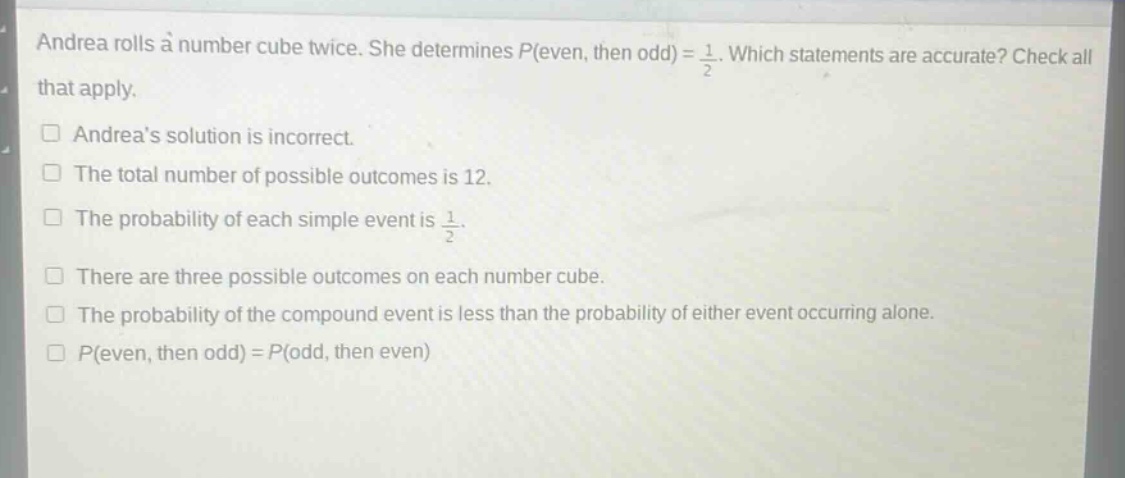
andrea rolls a number cube twice. she determines $p(even, then odd)=\frac{1}{2}$. which statements are accurate? check all that apply.\n□ andreas solution is incorrect.\n□ the total number of possible outcomes is 12.\n□ the probability of each simple event is $\frac{1}{2}$.\n□ there are three possible outcomes on each number cube.\n□ the probability of the compound event is less than the probability of either event occurring alone.\n□ $p(even, then odd)=p(odd, then even)$
Answer
Explanation:
Step1: Calculate total outcomes
A number - cube has 6 faces. When rolled twice, by the fundamental counting principle, the total number of possible outcomes is (6\times6 = 36), not 12.
Step2: Calculate probability of simple events
The probability of getting an even number ((2), (4), (6)) on a single roll of a number - cube is (P(\text{even})=\frac{3}{6}=\frac{1}{2}), and the probability of getting an odd number ((1), (3), (5)) on a single roll of a number - cube is (P(\text{odd})=\frac{3}{6}=\frac{1}{2}).
Step3: Calculate compound - event probability
Since the two rolls are independent events, (P(\text{even, then odd})=P(\text{even})\times P(\text{odd})=\frac{1}{2}\times\frac{1}{2}=\frac{1}{4}\neq\frac{1}{2}), so Andrea's solution is incorrect.
Step4: Analyze other statements
The probability of each simple event (even or odd on a single roll) is (\frac{1}{2}). There are 6 possible outcomes on each number - cube. The probability of a compound event (P(\text{even, then odd})=\frac{1}{4}), and (P(\text{even}) = P(\text{odd})=\frac{1}{2}), so the probability of the compound event is less than the probability of either event occurring alone. Also, (P(\text{odd, then even})=P(\text{odd})\times P(\text{even})=\frac{1}{2}\times\frac{1}{2}=\frac{1}{4}), so (P(\text{even, then odd}) = P(\text{odd, then even})).
Answer:
Andrea's solution is incorrect. The probability of each simple event is (\frac{1}{2}). The probability of the compound event is less than the probability of either event occurring alone. (P(\text{even, then odd}) = P(\text{odd, then even}))