the arrows on two spinners are spun one time. the first spinner is divided equally into the colors red…
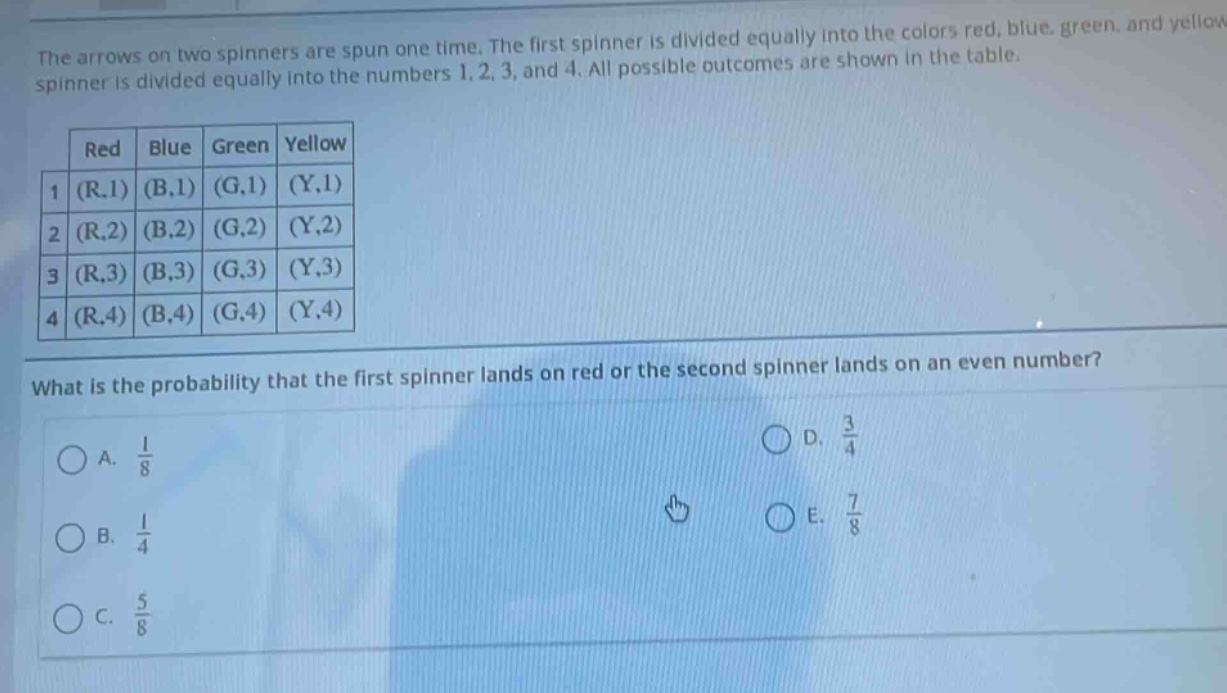
the arrows on two spinners are spun one time. the first spinner is divided equally into the colors red, blue, green, and yellow. the second spinner is divided equally into the numbers 1, 2, 3, and 4. all possible outcomes are shown in the table.\n| red | blue | green | yellow |\n|----|----|----|----|\n| 1 (r,1) | (b,1) | (g,1) | (y,1) |\n| 2 (r,2) | (b,2) | (g,2) | (y,2) |\n| 3 (r,3) | (b,3) | (g,3) | (y,3) |\n| 4 (r,4) | (b,4) | (g,4) | (y,4) |\nwhat is the probability that the first spinner lands on red or the second spinner lands on an even number?\na. $\frac{1}{8}$\nb. $\frac{1}{4}$\nc. $\frac{5}{8}$\nd. $\frac{3}{4}$\ne. $\frac{7}{8}$
Answer
Explanation:
Step1: Calculate total outcomes
There are 4 colors on the first - spinner and 4 numbers on the second - spinner. So the total number of outcomes is $4\times4 = 16$.
Step2: Calculate number of outcomes for first - spinner landing on red
The first - spinner landing on red has 4 outcomes: (R,1), (R,2), (R,3), (R,4).
Step3: Calculate number of outcomes for second - spinner landing on an even number
The second - spinner landing on an even number (2 or 4) has $4\times2=8$ outcomes: (R,2), (B,2), (G,2), (Y,2), (R,4), (B,4), (G,4), (Y,4).
Step4: Calculate number of overlapping outcomes
The overlapping outcomes (first - spinner on red and second - spinner on an even number) are (R,2) and (R,4), which is 2 outcomes.
Step5: Use the addition rule of probability
The addition rule for $P(A\cup B)=P(A)+P(B)-P(A\cap B)$. Here, $A$ is the event that the first - spinner lands on red and $B$ is the event that the second - spinner lands on an even number. $P(A)=\frac{4}{16}$, $P(B)=\frac{8}{16}$, and $P(A\cap B)=\frac{2}{16}$. Then $P(A\cup B)=\frac{4 + 8-2}{16}=\frac{10}{16}=\frac{5}{8}$.
Answer:
C. $\frac{5}{8}$