assume each newborn baby has a probability of approximately 0.53 of being female and 0.47 of being male. for…
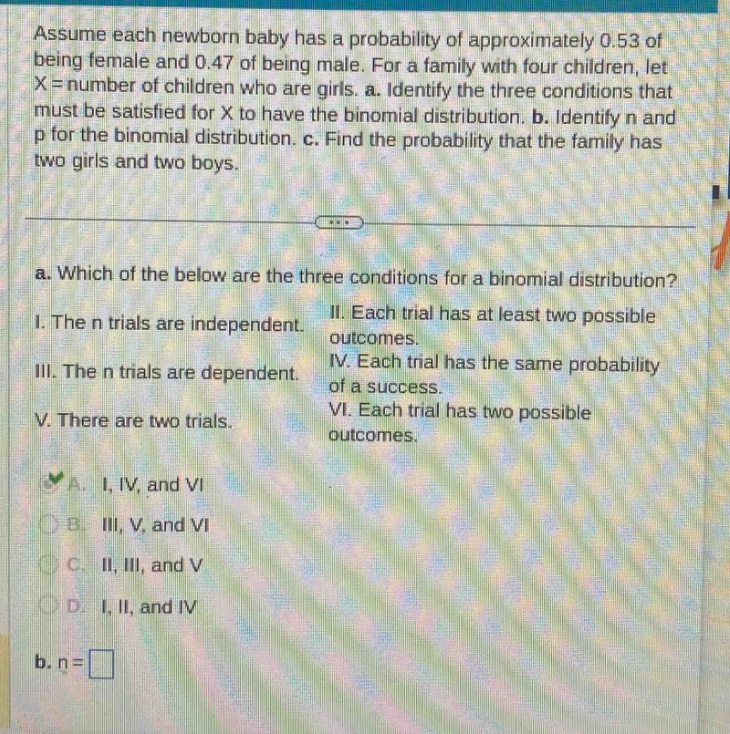
assume each newborn baby has a probability of approximately 0.53 of being female and 0.47 of being male. for a family with four children, let x = number of children who are girls. a. identify the three conditions that must be satisfied for x to have the binomial distribution. b. identify n and p for the binomial distribution. c. find the probability that the family has two girls and two boys. a. which of the below are the three conditions for a binomial distribution? i. the n trials are independent. ii. each trial has at least two possible outcomes. iii. the n trials are dependent. iv. each trial has the same probability of a success. v. there are two trials. vi. each trial has two possible outcomes. a. i, iv, and vi b. iii, v, and vi c. ii, iii, and v d. i, ii, and iv b. n =
Answer
Explanation:
Step1: Recall binomial - distribution conditions
The three conditions for a binomial distribution are: 1. The $n$ trials are independent. 2. Each trial has two possible outcomes (success or failure). 3. Each trial has the same probability of success. So the correct answer for part a is I, IV, and VI.
Step2: Identify $n$ and $p$
The number of trials $n$ is the number of children in the family. Here, $n = 4$. The probability of success $p$ is the probability of a child being a girl. So $p=0.53$.
Step3: Use binomial - probability formula
The binomial - probability formula is $P(X = k)=C(n,k)\times p^{k}\times(1 - p)^{n - k}$, where $C(n,k)=\frac{n!}{k!(n - k)!}$. We want to find the probability that $k = 2$ (2 girls), $n = 4$, and $p = 0.53$. First, calculate $C(4,2)=\frac{4!}{2!(4 - 2)!}=\frac{4!}{2!2!}=\frac{4\times3\times2!}{2!×2!}=\frac{4\times3}{2\times1}=6$. Then, $p = 0.53$ and $1 - p=0.47$. So $P(X = 2)=C(4,2)\times(0.53)^{2}\times(0.47)^{2}=6\times0.2809\times0.2209 = 6\times0.06205081=0.37230486\approx0.372$.
Answer:
a. A. I, IV, and VI b. $n = 4$ c. $0.372$