an athlete collected information on different brands of nutrition bars. she made a table showing the number…
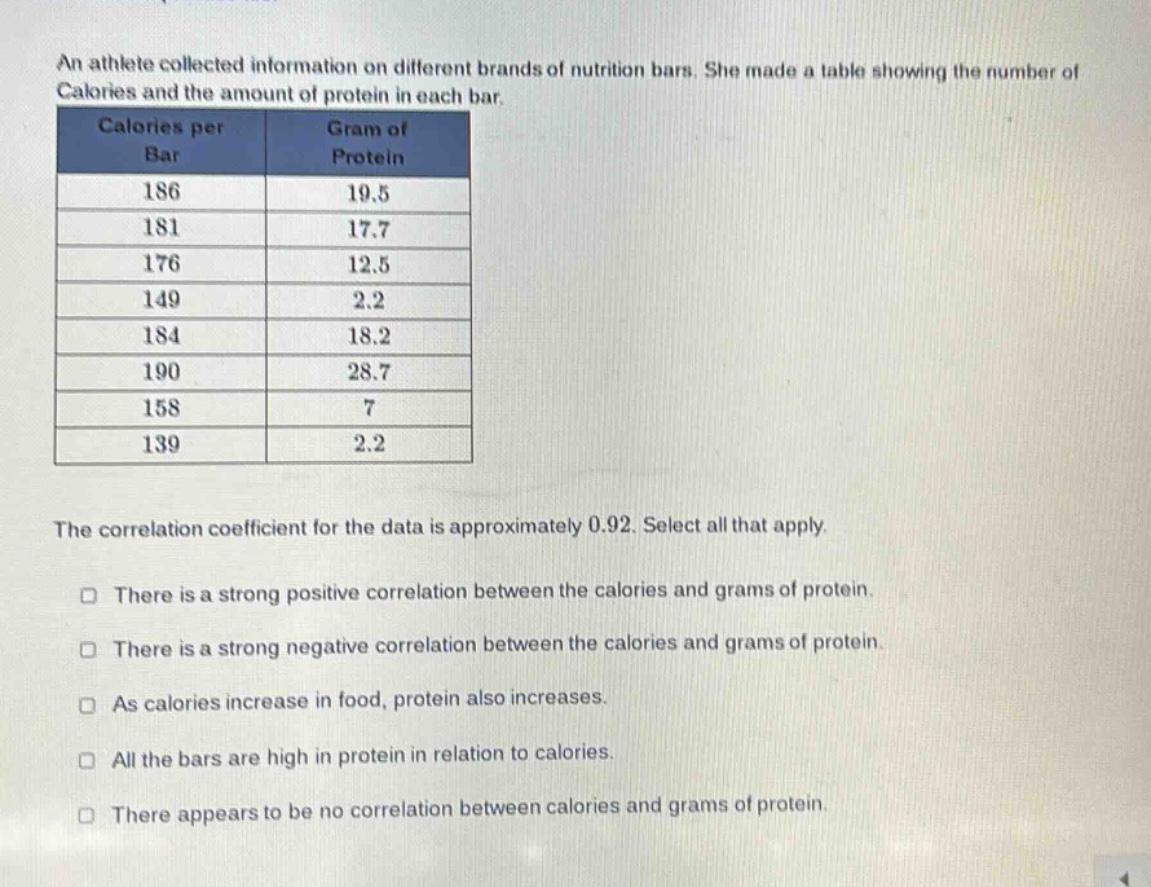
an athlete collected information on different brands of nutrition bars. she made a table showing the number of calories and the amount of protein in each bar.\n| calories per bar | gram of protein |\n| ---- | ---- |\n| 186 | 19.5 |\n| 181 | 17.7 |\n| 176 | 12.5 |\n| 149 | 2.2 |\n| 184 | 18.2 |\n| 190 | 28.7 |\n| 158 | 7 |\n| 139 | 2.2 |\nthe correlation coefficient for the data is approximately 0.92. select all that apply.\n□ there is a strong positive correlation between the calories and grams of protein.\n□ there is a strong negative correlation between the calories and grams of protein.\n□ as calories increase in food, protein also increases.\n□ all the bars are high in protein in relation to calories.\n□ there appears to be no correlation between calories and grams of protein.
Answer
Explanation:
Step1: Understand correlation coefficient
A correlation coefficient close to 1 indicates a strong positive correlation. Here, the correlation coefficient is approximately 0.92.
Step2: Analyze each statement
- Positive correlation means as one variable (calories) increases, the other (protein) also increases. Since 0.92 is close to 1, there is a strong positive correlation.
- A negative correlation would have a negative - valued correlation coefficient.
- Just because there is a positive correlation doesn't mean all bars are high in protein relative to calories. There is a relationship, but not a statement about the absolute levels.
- A correlation coefficient of 0.92 clearly shows a correlation, not no - correlation.
Answer:
There is a strong positive correlation between the calories and grams of protein. As calories increase in food, protein also increases.