attending to precision give the percent of the area under the normal curve represented by the shaded…
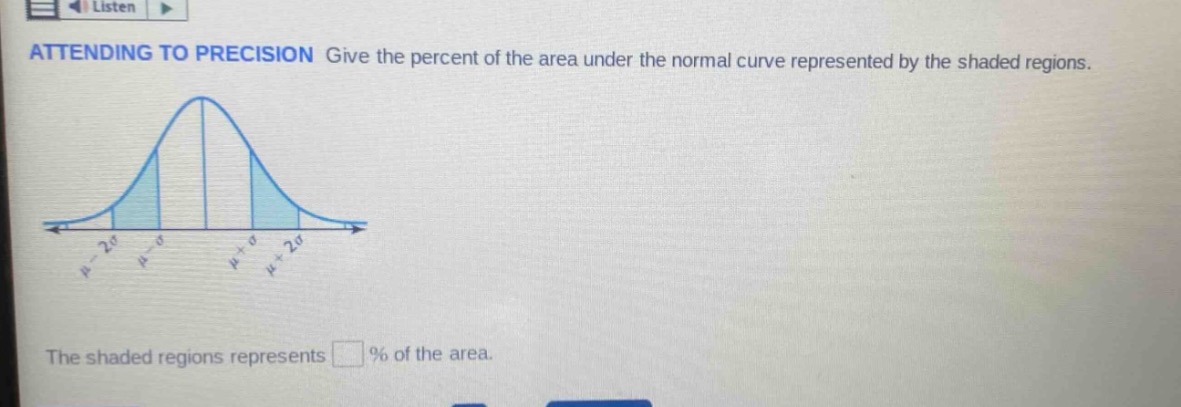
attending to precision give the percent of the area under the normal curve represented by the shaded regions. the shaded regions represents % of the area.
Answer
Explanation:
Step1: Recall normal - curve properties
The total area under the normal curve is 100%. The area within 1 standard - deviation ($\mu\pm\sigma$) of the mean is approximately 68%, and the area within 2 standard - deviations ($\mu\pm2\sigma$) of the mean is approximately 95%.
Step2: Calculate the area of the shaded regions
The area within $\mu - 2\sigma$ and $\mu - \sigma$ and between $\mu+\sigma$ and $\mu + 2\sigma$ can be found by subtracting the area within $\mu-\sigma$ and $\mu+\sigma$ from the area within $\mu - 2\sigma$ and $\mu + 2\sigma$. The area within $\mu - 2\sigma$ and $\mu + 2\sigma$ is about 95%, and the area within $\mu-\sigma$ and $\mu+\sigma$ is about 68%. The non - shaded area (within $\mu-\sigma$ and $\mu+\sigma$) is 68%. The remaining area (the two shaded tails) is $95 - 68=27$. Since the normal curve is symmetric, the area of each tail is $\frac{27}{2}=13.5$. The total area of the two shaded regions is $13.5\times2 = 27$.
Answer:
27