on average, a persons body temperature should be approximately 98.6°f. a doctor would like to test the…
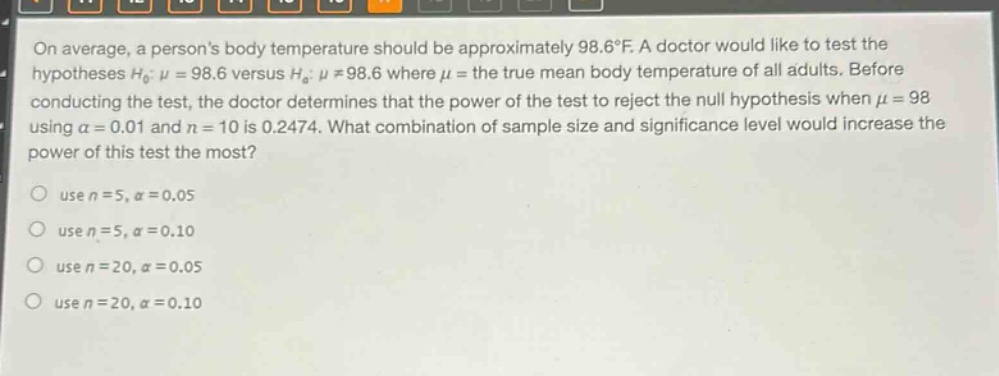
on average, a persons body temperature should be approximately 98.6°f. a doctor would like to test the hypotheses $h_0: mu = 98.6$ versus $h_a: mu\neq98.6$ where $mu$ = the true mean body temperature of all adults. before conducting the test, the doctor determines that the power of the test to reject the null hypothesis when $mu = 98$ using $alpha = 0.01$ and $n = 10$ is 0.2474. what combination of sample size and significance level would increase the power of this test the most?\nuse $n = 5,alpha = 0.05$\nuse $n = 5,alpha = 0.10$\nuse $n = 20,alpha = 0.05$\nuse $n = 20,alpha = 0.10$
Answer
Explanation:
Step1: Understand power - sample size - significance relationship
The power of a hypothesis test is affected by sample size ($n$) and significance level ($\alpha$). Larger sample size and larger significance level increase power.
Step2: Analyze each option
- Option 1: $n = 5$, $\alpha=0.05$. Smaller $n$ compared to other options with larger $\alpha$ values, so power is not maximized.
- Option 2: $n = 5$, $\alpha = 0.10$. Small $n$ reduces power despite larger $\alpha$.
- Option 3: $n = 20$, $\alpha=0.05$. Larger $n$ but smaller $\alpha$ compared to next option.
- Option 4: $n = 20$, $\alpha = 0.10$. Has both large $n$ and large $\alpha$.
Answer:
use $n = 20$, $\alpha = 0.10$