an avid traveler is investigating whether travel websites differ in their pricing. she chooses a random…
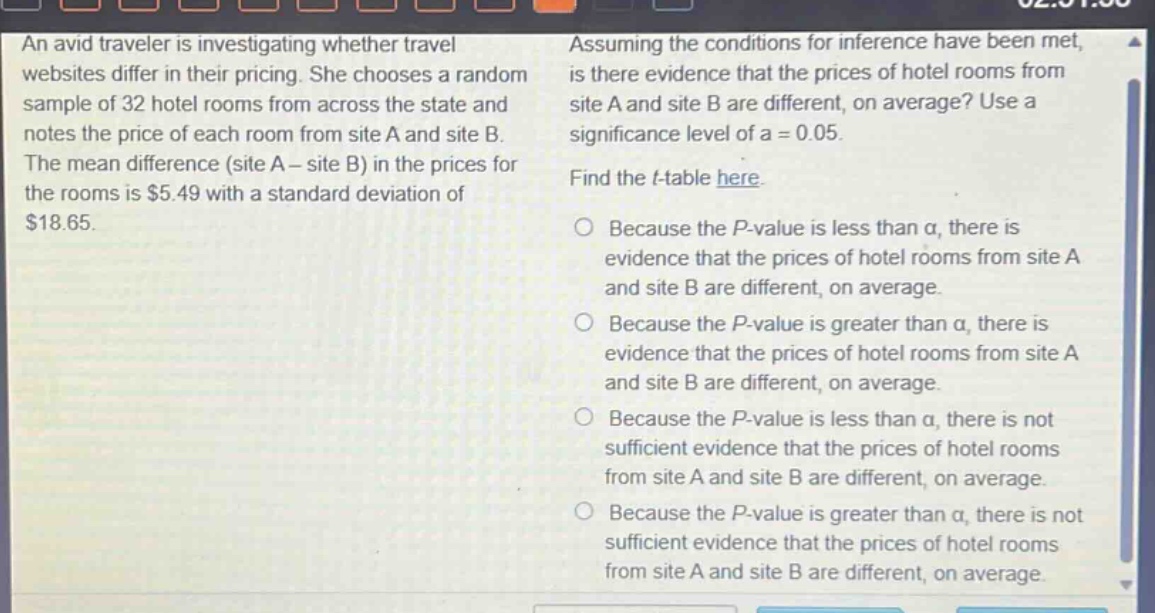
an avid traveler is investigating whether travel websites differ in their pricing. she chooses a random sample of 32 hotel rooms from across the state and notes the price of each room from site a and site b. the mean difference (site a - site b) in the prices for the rooms is $5.49 with a standard deviation of $18.65. assuming the conditions for inference have been met, is there evidence that the prices of hotel rooms from site a and site b are different, on average? use a significance level of a = 0.05. find the t - table here. because the p - value is less than a, there is evidence that the prices of hotel rooms from site a and site b are different, on average. because the p - value is greater than a, there is evidence that the prices of hotel rooms from site a and site b are different, on average. because the p - value is less than a, there is not sufficient evidence that the prices of hotel rooms from site a and site b are different, on average. because the p - value is greater than a, there is not sufficient evidence that the prices of hotel rooms from site a and site b are different, on average.
Answer
Explanation:
Step1: Calculate the t - statistic
We use the formula for the t - statistic in a paired - samples t - test: $t=\frac{\bar{d}}{s_d/\sqrt{n}}$, where $\bar{d}$ is the mean difference, $s_d$ is the standard deviation of the differences, and $n$ is the sample size. Here, $\bar{d} = 5.49$, $s_d=18.65$, and $n = 32$. So, $t=\frac{5.49}{18.65/\sqrt{32}}\approx\frac{5.49}{18.65/5.657}\approx\frac{5.49}{3.3}\approx1.66$.
Step2: Determine the degrees of freedom
For a paired - samples t - test, the degrees of freedom is $df=n - 1$. So, $df=32-1 = 31$.
Step3: Find the P - value
Using the t - table with $df = 31$ and a two - tailed test (since we are testing if the means are different), and our calculated $t\approx1.66$. Looking up the value in the t - table or using statistical software, we find the P - value. For a two - tailed test with $t = 1.66$ and $df=31$, the P - value is greater than 0.05.
Step4: Make a decision
We compare the P - value with the significance level $\alpha=0.05$. If $P<\alpha$, we reject the null hypothesis. If $P>\alpha$, we fail to reject the null hypothesis. Since $P > 0.05$, we fail to reject the null hypothesis.
Answer:
Because the P - value is greater than $\alpha$, there is not sufficient evidence that the prices of hotel rooms from site A and site B are different, on average.