baby weights: the weight of male babies less than 2 months old in the united states is normally distributed…
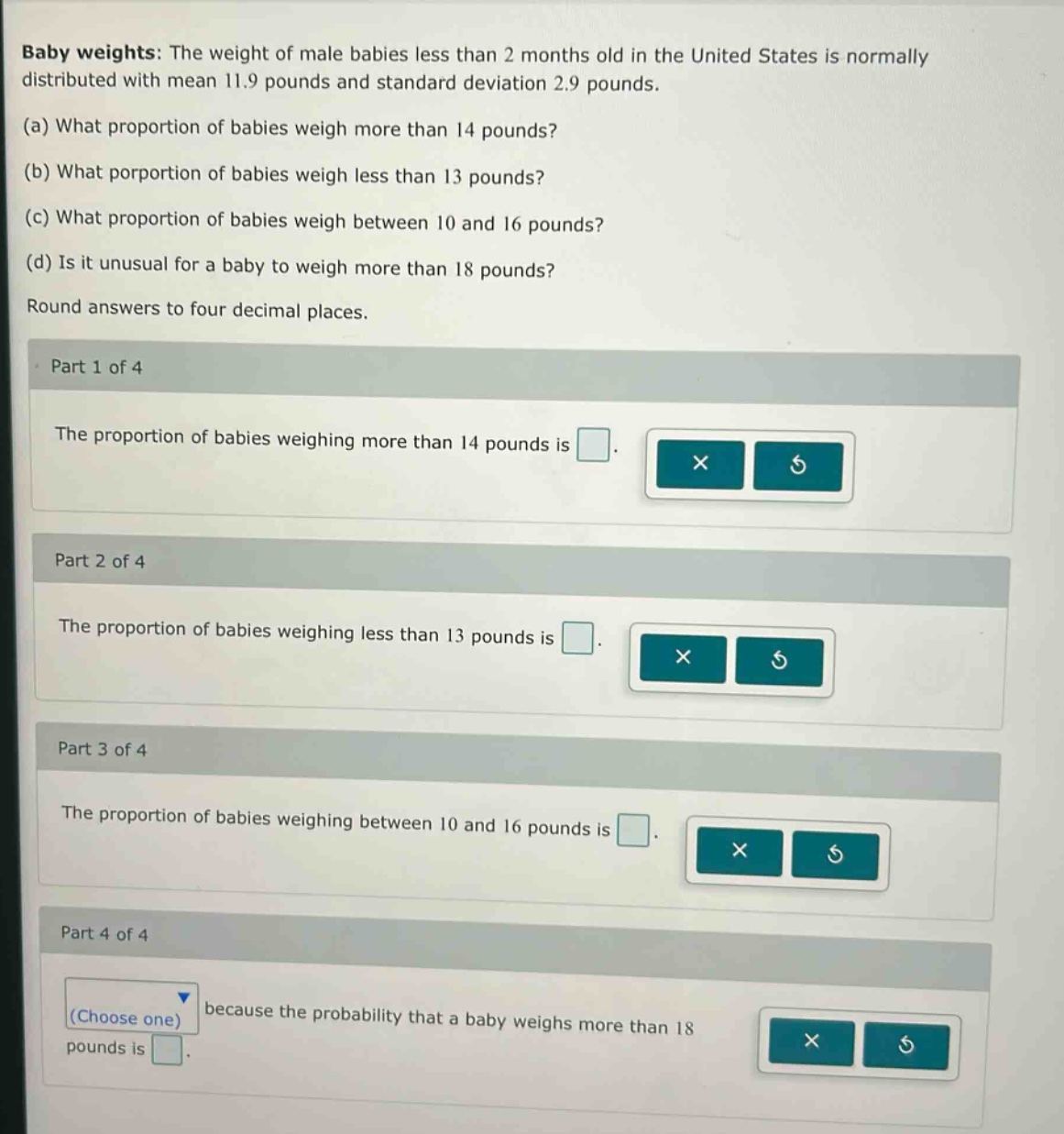
baby weights: the weight of male babies less than 2 months old in the united states is normally distributed with mean 11.9 pounds and standard deviation 2.9 pounds.\n(a) what proportion of babies weigh more than 14 pounds?\n(b) what porportion of babies weigh less than 13 pounds?\n(c) what proportion of babies weigh between 10 and 16 pounds?\n(d) is it unusual for a baby to weigh more than 18 pounds?\nround answers to four decimal places.\npart 1 of 4\nthe proportion of babies weighing more than 14 pounds is \npart 2 of 4\nthe proportion of babies weighing less than 13 pounds is \npart 3 of 4\nthe proportion of babies weighing between 10 and 16 pounds is \npart 4 of 4\n(choose one) because the probability that a baby weighs more than 18 pounds is
Answer
Explanation:
Step1: Calculate z - score formula
The z - score formula is $z=\frac{x-\mu}{\sigma}$, where $\mu = 11.9$ (mean), $\sigma=2.9$ (standard deviation), and $x$ is the value from the data set.
Step2: Solve part (a)
For $x = 14$, $z=\frac{14 - 11.9}{2.9}=\frac{2.1}{2.9}\approx0.7241$. We want $P(X>14)=1 - P(X\leq14)$. Looking up $z = 0.7241$ in the standard - normal table, $P(Z\leq0.7241)\approx0.7657$. So $P(X>14)=1 - 0.7657 = 0.2343$.
Step3: Solve part (b)
For $x = 13$, $z=\frac{13 - 11.9}{2.9}=\frac{1.1}{2.9}\approx0.3793$. Looking up $z = 0.3793$ in the standard - normal table, $P(Z\leq0.3793)\approx0.6478$.
Step4: Solve part (c)
For $x = 10$, $z_1=\frac{10 - 11.9}{2.9}=\frac{-1.9}{2.9}\approx - 0.6552$. For $x = 16$, $z_2=\frac{16 - 11.9}{2.9}=\frac{4.1}{2.9}\approx1.4138$. $P(10<X<16)=P(Z<1.4138)-P(Z < - 0.6552)$. Looking up in the standard - normal table, $P(Z<1.4138)\approx0.9217$ and $P(Z < - 0.6552)\approx0.2562$. So $P(10<X<16)=0.9217-0.2562 = 0.6655$.
Step5: Solve part (d)
For $x = 18$, $z=\frac{18 - 11.9}{2.9}=\frac{6.1}{2.9}\approx2.1034$. $P(X>18)=1 - P(X\leq18)$. Looking up $z = 2.1034$ in the standard - normal table, $P(Z\leq2.1034)\approx0.9822$. So $P(X>18)=1 - 0.9822 = 0.0178$. Since $P(X>18)=0.0178<0.05$, it is unusual.
Answer:
Part 1 of 4: $0.2343$ Part 2 of 4: $0.6478$ Part 3 of 4: $0.6655$ Part 4 of 4: Yes; $0.0178$