a bag contains eight yellow marbles, nine green marbles, three purple marbles, and five red marbles. three…
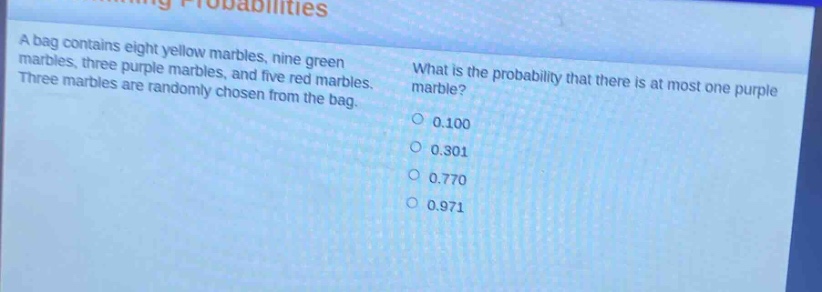
a bag contains eight yellow marbles, nine green marbles, three purple marbles, and five red marbles. three marbles are randomly chosen from the bag. what is the probability that there is at most one purple marble? 0.100 0.301 0.770 0.971
Answer
Explanation:
Step1: Calculate total number of marbles
$8 + 9+3 + 5=25$ marbles.
Step2: Define the probability formula for combinations
The probability $P(X = k)=\frac{C(n_1,k)\times C(n_2,n - k)}{C(n,n)}$, where $n$ is the total number of marbles, $n_1$ is the number of purple marbles, $n_2$ is the number of non - purple marbles, $n$ is the number of marbles chosen, and $k$ is the number of purple marbles chosen. We want $P(X\leq1)=P(X = 0)+P(X = 1)$.
Step3: Calculate $P(X = 0)$
$n_1 = 3$ (purple marbles), $n_2=22$ (non - purple marbles), $n = 3$. $C(3,0)=\frac{3!}{0!(3 - 0)!}=1$, $C(22,3)=\frac{22!}{3!(22 - 3)!}=\frac{22\times21\times20}{3\times2\times1}=1540$, $C(25,3)=\frac{25!}{3!(25 - 3)!}=\frac{25\times24\times23}{3\times2\times1}=2300$. $P(X = 0)=\frac{C(3,0)\times C(22,3)}{C(25,3)}=\frac{1\times1540}{2300}\approx0.6696$.
Step4: Calculate $P(X = 1)$
$C(3,1)=\frac{3!}{1!(3 - 1)!}=3$, $C(22,2)=\frac{22!}{2!(22 - 2)!}=\frac{22\times21}{2\times1}=231$. $P(X = 1)=\frac{C(3,1)\times C(22,2)}{C(25,3)}=\frac{3\times231}{2300}\approx0.2996$.
Step5: Calculate $P(X\leq1)$
$P(X\leq1)=P(X = 0)+P(X = 1)\approx0.6696 + 0.2996=0.9692\approx0.971$.
Answer:
$0.971$