1. a bag contains 3 grape, 2 lime, and 4 cherry candies. which of the following calculations can be used to…
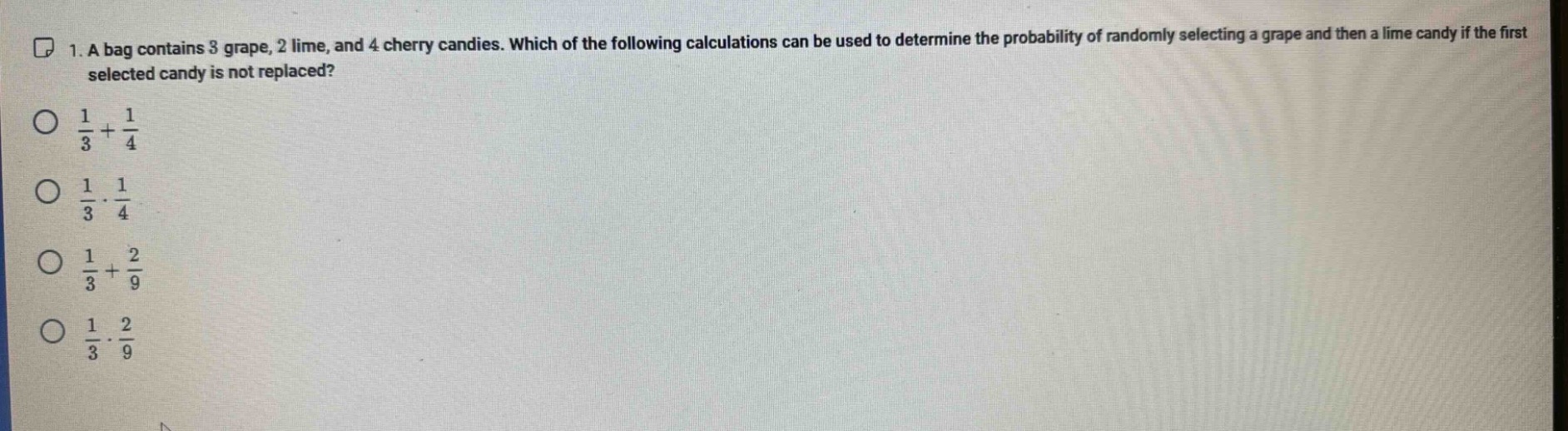
1. a bag contains 3 grape, 2 lime, and 4 cherry candies. which of the following calculations can be used to determine the probability of randomly selecting a grape and then a lime candy if the first selected candy is not replaced?\n$\frac{1}{3}+\frac{1}{4}$\n$\frac{1}{3}cdot\frac{1}{4}$\n$\frac{1}{3}+\frac{2}{9}$\n$\frac{1}{3}cdot\frac{2}{9}$
Answer
Explanation:
Step1: Calculate total number of candies
Total candies = 3 (grape) + 2 (lime) + 4 (cherry) = 9
Step2: Calculate probability of selecting a grape candy first
Probability of grape = $\frac{3}{9}=\frac{1}{3}$
Step3: Calculate probability of selecting a lime candy second (without replacement)
After one grape candy is taken, there are 8 candies left. Probability of lime = $\frac{2}{8}=\frac{1}{4}$
Step4: Use multiplication rule for independent - like events (without replacement)
The probability of both events happening is the product of their probabilities. So the probability of selecting a grape then a lime is $\frac{1}{3}\times\frac{1}{4}$
Answer:
$\frac{1}{3}\cdot\frac{1}{4}$ (the second option)