a bag contains 6 red marbles, 8 blue marbles and 3 green marbles. if three marbles are drawn out of the bag…
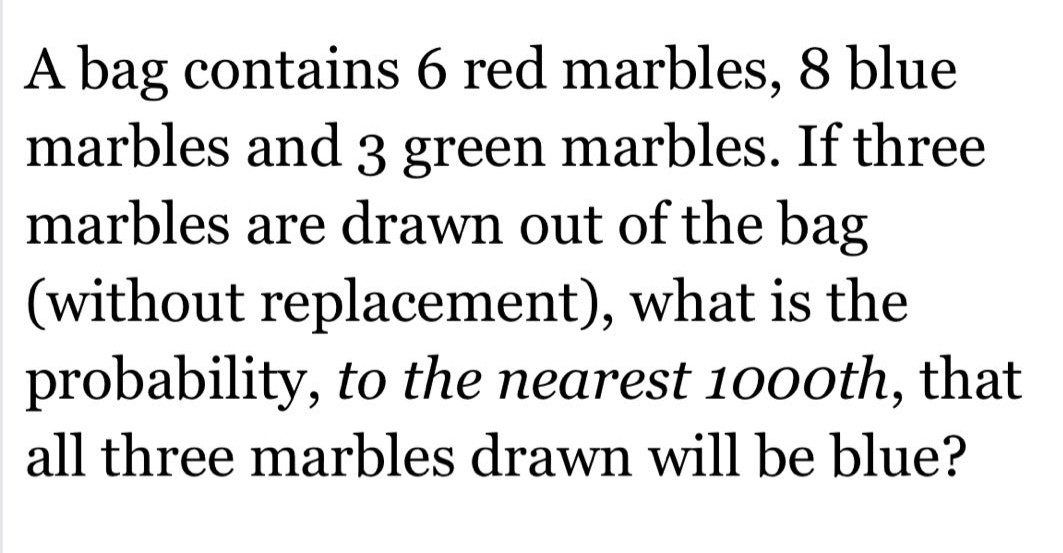
a bag contains 6 red marbles, 8 blue marbles and 3 green marbles. if three marbles are drawn out of the bag (without replacement), what is the probability, to the nearest 1000th, that all three marbles drawn will be blue?
Answer
Explanation:
Step1: Calculate total marbles
Total marbles = 6 + 8+ 3 = 17
Step2: Calculate first - draw probability
Probability of first blue - draw = $\frac{8}{17}$
Step3: Calculate second - draw probability
After one blue marble is drawn, there are 7 blue marbles and 16 total marbles left. Probability of second blue - draw = $\frac{7}{16}$
Step4: Calculate third - draw probability
After two blue marbles are drawn, there are 6 blue marbles and 15 total marbles left. Probability of third blue - draw = $\frac{6}{15}$
Step5: Calculate combined probability
Since these are dependent events, the probability that all three are blue is the product of the probabilities of each draw. $P=\frac{8}{17}\times\frac{7}{16}\times\frac{6}{15}=\frac{8\times7\times6}{17\times16\times15}=\frac{336}{4080}\approx0.082$
Answer:
0.082