a bag contains 2 red marbles, 4 blue marbles and 5 green marbles. if two marbles are drawn out of the bag…
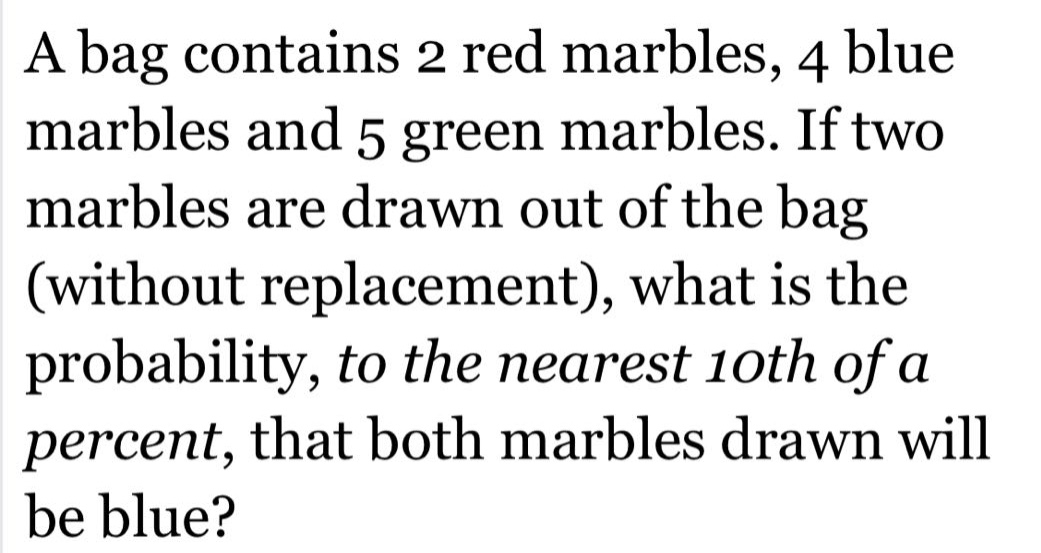
a bag contains 2 red marbles, 4 blue marbles and 5 green marbles. if two marbles are drawn out of the bag (without replacement), what is the probability, to the nearest 10th of a percent, that both marbles drawn will be blue?
Answer
Explanation:
Step1: Calculate total marbles
The total number of marbles is $2 + 4+5=11$.
Step2: Calculate first - draw probability
The probability of drawing a blue marble on the first draw is $\frac{4}{11}$ since there are 4 blue marbles out of 11 total marbles.
Step3: Calculate second - draw probability
After drawing one blue marble on the first draw (without replacement), there are 3 blue marbles left and 10 total marbles left. So the probability of drawing a blue marble on the second draw is $\frac{3}{10}$.
Step4: Calculate combined probability
The probability of both events happening is the product of their probabilities. So $P=\frac{4}{11}\times\frac{3}{10}=\frac{12}{110}=\frac{6}{55}\approx 0.109$. To convert to a percentage, we multiply by 100: $0.109\times100 = 10.9%$.
Answer:
$10.9%$