4. a bag contains 9 tiles, one for each letter in the word happiness. you choose a tile at random. what is…
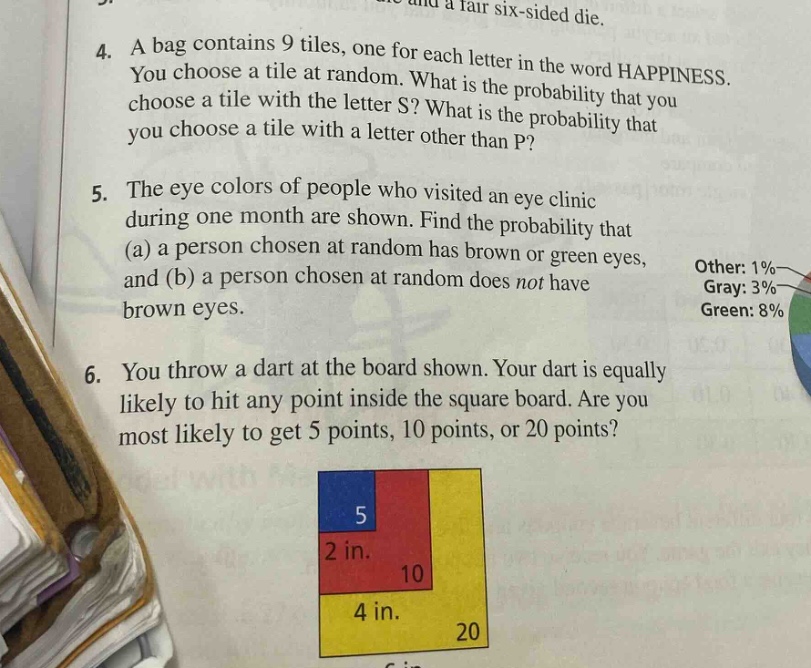
4. a bag contains 9 tiles, one for each letter in the word happiness. you choose a tile at random. what is the probability that you choose a tile with the letter s? what is the probability that you choose a tile with a letter other than p?\n5. the eye colors of people who visited an eye clinic during one month are shown. find the probability that (a) a person chosen at random has brown or green eyes, and (b) a person chosen at random does not have brown eyes.\nother: 1%\ngray: 3%\ngreen: 8%\n6. you throw a dart at the board shown. your dart is equally likely to hit any point inside the square board. are you most likely to get 5 points, 10 points, or 20 points?
Answer
4.
Explanation:
Step1: Calculate probability of choosing S
The word HAPPINESS has 2 S's. There are 9 tiles in total. Probability = number of favorable outcomes / total number of outcomes. $P(S)=\frac{2}{9}$
Step2: Calculate probability of not choosing P
The word HAPPINESS has 3 P's. So number of non - P letters is $9 - 3=6$. $P(\text{not }P)=\frac{6}{9}=\frac{2}{3}$
Answer:
The probability of choosing S is $\frac{2}{9}$, and the probability of choosing a letter other than P is $\frac{2}{3}$.
5.
Explanation:
Step1: Calculate probability of brown or green eyes
Let's assume the percentage of brown - eyed people is $x$. We know $P(\text{green}) = 8%$ and assume $P(\text{brown})=y$. Since the sum of all probabilities is 100%, if we assume the given percentages for other eye - colors are all accounted for, and we know $P(\text{other}) = 1%$, $P(\text{gray})=3%$, $P(\text{green}) = 8%$. Then $P(\text{brown})=100-(1 + 3+8)=88%$. $P(\text{brown or green})=P(\text{brown})+P(\text{green})=88%+8% = 96%$ or $0.96$
Step2: Calculate probability of not having brown eyes
$P(\text{not brown})=1 - P(\text{brown})=1 - 0.88 = 0.12$
Answer:
(a) The probability that a person chosen at random has brown or green eyes is $0.96$. (b) The probability that a person chosen at random does not have brown eyes is $0.12$.
6.
Explanation:
Step1: Calculate area of each region
The area of the region for 5 - point is $A_1=2\times2 = 4$ square inches. The area of the region for 10 - point is $A_2=(4)\times(2)=8$ square inches. The area of the region for 20 - point is $A_3=(4)\times(4)=16$ square inches.
Step2: Calculate probabilities
The total area of the board is $A = 4 + 8+16=28$ square inches. $P(5)=\frac{4}{28}=\frac{1}{7}$, $P(10)=\frac{8}{28}=\frac{2}{7}$, $P(20)=\frac{16}{28}=\frac{4}{7}$
Answer:
You are most likely to get 20 points.