a bag is filled with 26 letter tiles, one for each letter in the alphabet. find the probability of choosing…
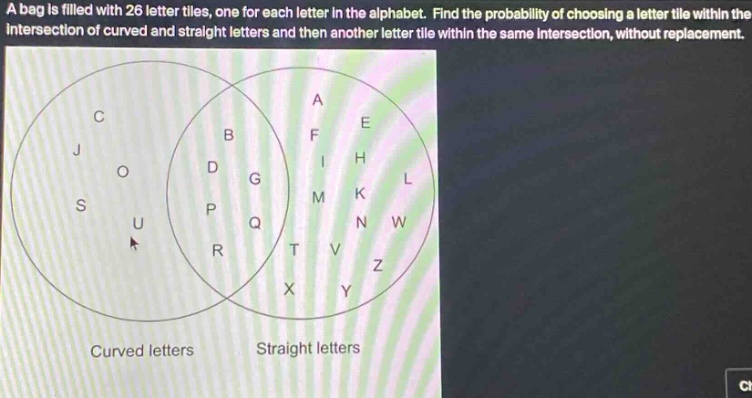
a bag is filled with 26 letter tiles, one for each letter in the alphabet. find the probability of choosing a letter tile within the intersection of curved and straight letters and then another letter tile within the same intersection, without replacement.
Answer
Explanation:
Step1: Count intersection elements
The intersection of curved and straight - letter tiles has 5 elements (B, D, P, Q, R).
Step2: Calculate first - draw probability
The probability of choosing a letter tile from the intersection on the first draw is $\frac{5}{26}$ since there are 5 favorable outcomes out of 26 total outcomes.
Step3: Calculate second - draw probability
Since there is no replacement, for the second draw, there are 4 favorable outcomes left out of 25 total outcomes. So the probability is $\frac{4}{25}$.
Step4: Calculate combined probability
The probability of both events occurring is the product of the probabilities of each event. So $P=\frac{5}{26}\times\frac{4}{25}$. $P = \frac{5\times4}{26\times25}=\frac{20}{650}=\frac{2}{65}$
Answer:
$\frac{2}{65}$