bart found 20 quadrilaterals in his classroom. he made a venn diagram using the properties of the…
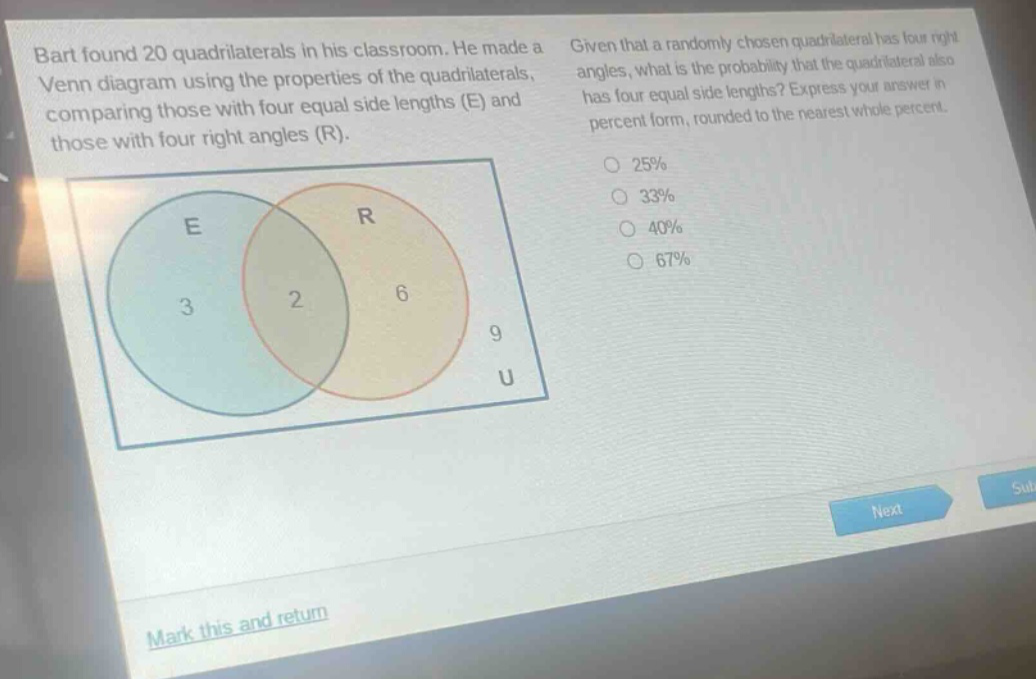
bart found 20 quadrilaterals in his classroom. he made a venn diagram using the properties of the quadrilaterals, comparing those with four equal side lengths (e) and those with four right angles (r). given that a randomly - chosen quadrilateral has four right angles, what is the probability that the quadrilateral also has four equal side lengths? express your answer in percent form, rounded to the nearest whole percent. 25% 33% 40% 67%
Answer
Answer:
25%
Explanation:
Step1: Identify relevant values
The number of quadrilaterals with four right - angles is $6 + 2=8$. The number of quadrilaterals with four right - angles and four equal side lengths is $2$.
Step2: Calculate the probability
The probability formula for conditional probability is $P(A|B)=\frac{P(A\cap B)}{P(B)}$. In terms of counts, if $A$ is the event of having four equal side lengths and $B$ is the event of having four right - angles, the probability is $\frac{n(A\cap B)}{n(B)}$. So the probability $P=\frac{2}{8}=0.25$.
Step3: Convert to percentage
To convert the decimal to a percentage, we multiply by 100. $0.25\times100 = 25%$.