based on the histogram, which of these statements are true? on average, kids in her neighborhood have about…
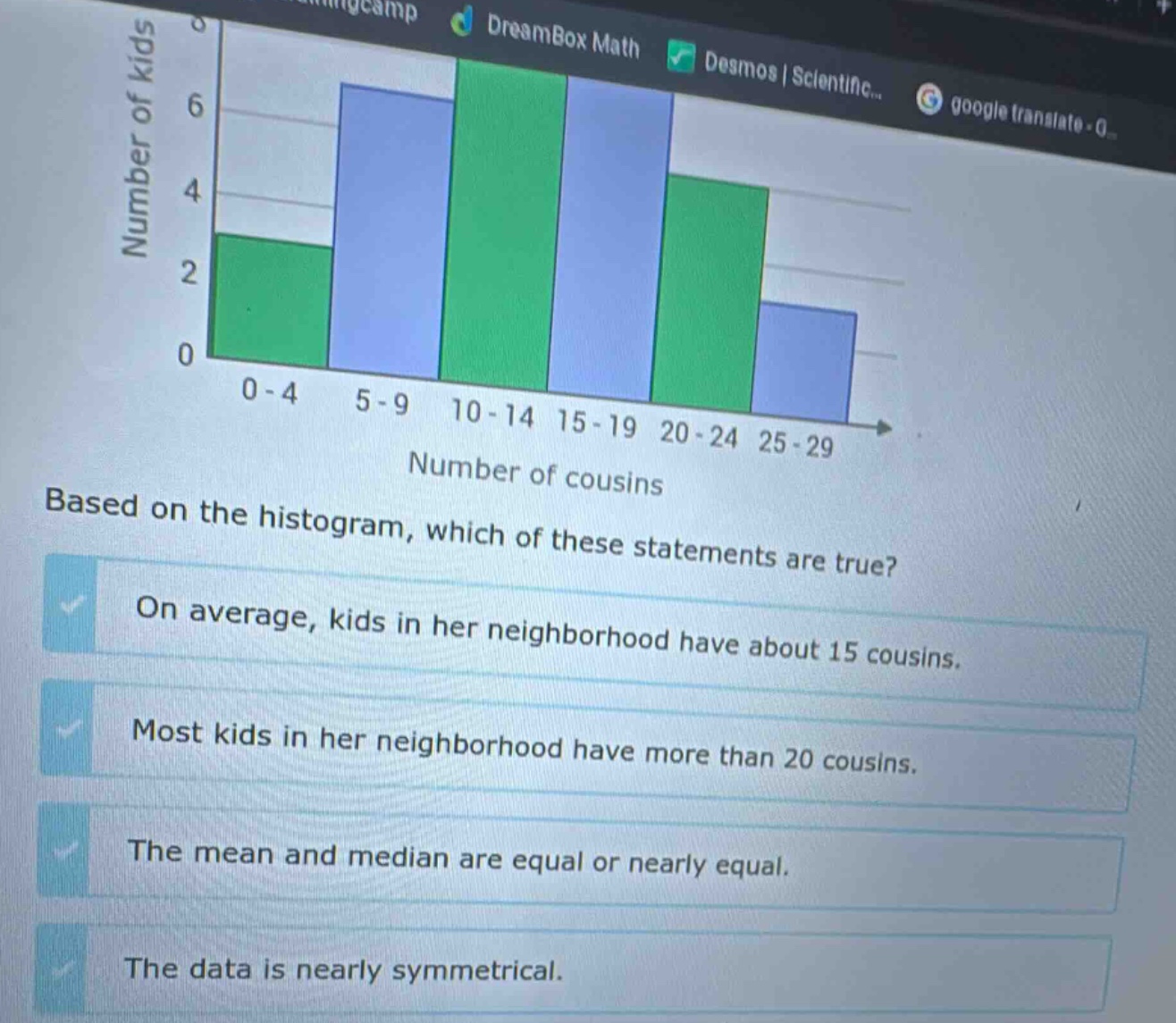
based on the histogram, which of these statements are true? on average, kids in her neighborhood have about 15 cousins. most kids in her neighborhood have more than 20 cousins. the mean and median are equal or nearly equal. the data is nearly symmetrical.
Answer
Explanation:
Step1: Analyze average statement
We cannot determine the average precisely from the histogram, but visually the center - like value seems around 15.
Step2: Analyze number of kids with more than 20 cousins
The number of kids in the 20 - 24 and 25 - 29 intervals is 4 + 1=5, while the number of kids in the 5 - 19 intervals is 6+7 + 6 = 19. So most kids do not have more than 20 cousins.
Step3: Analyze mean - median relationship
Since the data is not symmetric (right - skewed as there is a long tail on the right), the mean and median are not equal or nearly equal.
Step4: Analyze symmetry
The data is right - skewed (more data on the left side of the distribution), so it is not nearly symmetrical.