becky and carla take an advanced yoga class. becky can hold 29% of her poses for over a minute, while carla…
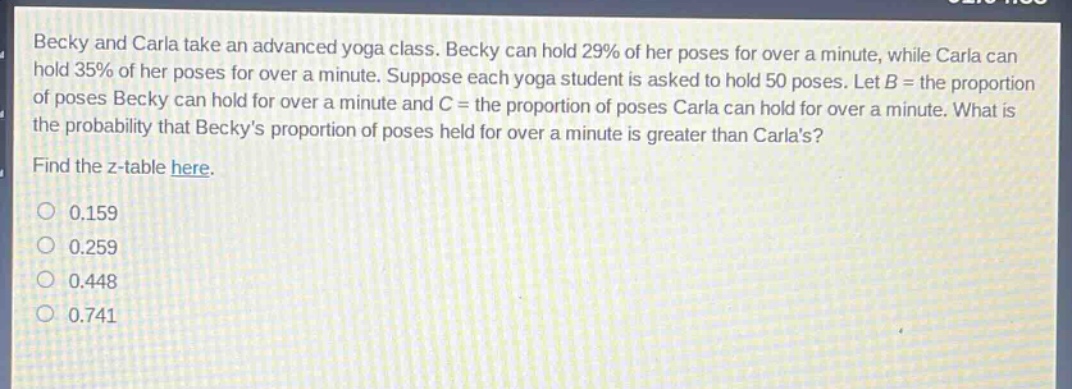
becky and carla take an advanced yoga class. becky can hold 29% of her poses for over a minute, while carla can hold 35% of her poses for over a minute. suppose each yoga student is asked to hold 50 poses. let b = the proportion of poses becky can hold for over a minute and c = the proportion of poses carla can hold for over a minute. what is the probability that beckys proportion of poses held for over a minute is greater than carlas? find the z - table here. 0.159 0.259 0.448 0.741
Answer
Answer:
0.259
Explanation:
Step1: Calculate mean of difference
The mean of the sampling - distribution of (B - C) is (\mu_{B - C}=p_B - p_C). Given (p_B = 0.29) and (p_C = 0.35), so (\mu_{B - C}=0.29-0.35=- 0.06).
Step2: Calculate standard deviation of difference
The standard deviation of the sampling - distribution of (B - C) is (\sigma_{B - C}=\sqrt{\frac{p_B(1 - p_B)}{n}+\frac{p_C(1 - p_C)}{n}}), where (n = 50). [ \begin{align*} \sigma_{B - C}&=\sqrt{\frac{0.29\times(1 - 0.29)}{50}+\frac{0.35\times(1 - 0.35)}{50}}\ &=\sqrt{\frac{0.29\times0.71}{50}+\frac{0.35\times0.65}{50}}\ &=\sqrt{\frac{0.2059}{50}+\frac{0.2275}{50}}\ &=\sqrt{\frac{0.2059 + 0.2275}{50}}\ &=\sqrt{\frac{0.4334}{50}}\ &=\sqrt{0.008668}\ &\approx0.0931 \end{align*} ]
Step3: Calculate z - score
We want to find (P(B>C)), which is equivalent to (P(B - C>0)). The z - score is (z=\frac{(B - C)-\mu_{B - C}}{\sigma_{B - C}}). Substituting (B - C = 0), (\mu_{B - C}=-0.06) and (\sigma_{B - C}\approx0.0931) into the formula, we get (z=\frac{0-(-0.06)}{0.0931}=\frac{0.06}{0.0931}\approx0.64).
Step4: Find probability from z - table
(P(B - C>0)=1 - P(B - C\leqslant0)). Looking up the z - value of (0.64) in the standard normal (z) table, (P(Z\leqslant0.64) = 0.7389). So (P(B - C>0)=1 - 0.7389 = 0.2611\approx0.259) (due to rounding differences in the z - table and calculations).