at the beginning of the semester, a professor tells students that if they study for the tests, then there is…
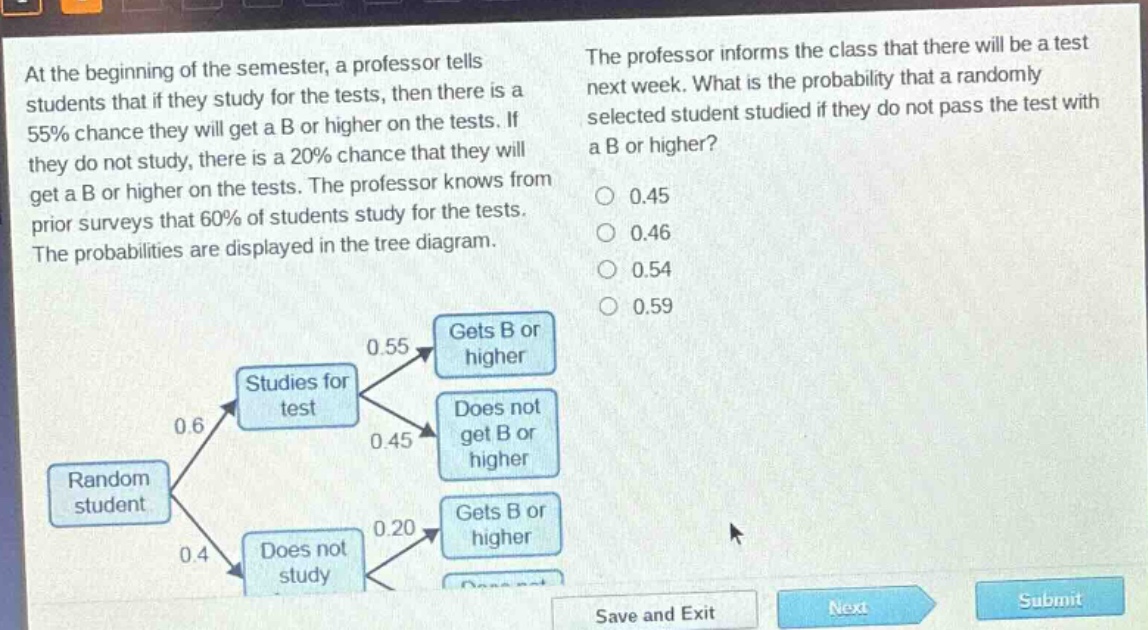
at the beginning of the semester, a professor tells students that if they study for the tests, then there is a 55% chance they will get a b or higher on the tests. if they do not study, there is a 20% chance that they will get a b or higher on the tests. the professor knows from prior surveys that 60% of students study for the tests. the probabilities are displayed in the tree diagram. the professor informs the class that there will be a test next week. what is the probability that a randomly selected student studied if they do not pass the test with a b or higher? 0.45 0.46 0.54 0.59
Answer
Explanation:
Step1: Define events and probabilities
Let $S$ be the event that a student studies and $\overline{S}$ be the event that a student does not - study. Let $B$ be the event that a student gets a B or higher and $\overline{B}$ be the event that a student does not get a B or higher. We know $P(S)=0.6$, $P(\overline{S}) = 0.4$, $P(B|S)=0.55$, $P(\overline{B}|S)=0.45$, $P(B|\overline{S}) = 0.20$, $P(\overline{B}|\overline{S})=0.80$. We want to find $P(S|\overline{B})$.
Step2: Use Bayes' theorem
Bayes' theorem states that $P(S|\overline{B})=\frac{P(\overline{B}|S)P(S)}{P(\overline{B}|S)P(S)+P(\overline{B}|\overline{S})P(\overline{S})}$.
Step3: Calculate the denominator
First, calculate the denominator $P(\overline{B}|S)P(S)+P(\overline{B}|\overline{S})P(\overline{S})$. $P(\overline{B}|S)P(S)=0.45\times0.6 = 0.27$. $P(\overline{B}|\overline{S})P(\overline{S})=0.80\times0.4 = 0.32$. The sum is $0.27 + 0.32=0.59$.
Step4: Calculate the numerator
The numerator is $P(\overline{B}|S)P(S)=0.45\times0.6 = 0.27$.
Step5: Calculate $P(S|\overline{B})$
$P(S|\overline{B})=\frac{0.27}{0.59}\approx0.46$.
Answer:
0.46