belleville high school offers classes on three different foreign languages. let a be the event that a…
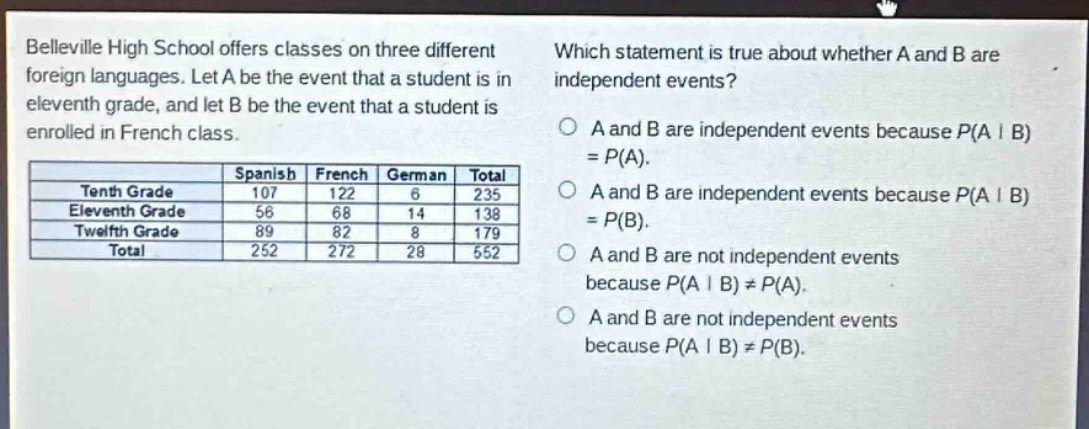
belleville high school offers classes on three different foreign languages. let a be the event that a student is in eleventh grade, and let b be the event that a student is enrolled in french class.\n| | spanish | french | german | total |\n|--|--|--|--|--|\n| tenth grade | 107 | 122 | 6 | 235 |\n| eleventh grade | 56 | 68 | 14 | 138 |\n| twelfth grade | 89 | 82 | 8 | 179 |\n| total | 252 | 272 | 28 | 552 |\nwhich statement is true about whether a and b are independent events?\na and b are independent events because p(a | b)=p(a).\na and b are independent events because p(a | b)=p(b).\na and b are not independent events because p(a | b)≠p(a).\na and b are not independent events because p(a | b)≠p(b).
Answer
Explanation:
Step1: Recall the definition of independent events
Two events (A) and (B) are independent if (P(A|B)=P(A)). The conditional - probability (P(A|B)=\frac{P(A\cap B)}{P(B)}), and (P(A)) is the probability of event (A) occurring without any condition.
Step2: Calculate (P(A))
The total number of students is (n = 552). The number of eleventh - grade students (n(A)=138). So (P(A)=\frac{n(A)}{n}=\frac{138}{552}=\frac{1}{4}).
Step3: Calculate (P(A\cap B))
The number of eleventh - grade students in French class is (n(A\cap B) = 68). So (P(A\cap B)=\frac{n(A\cap B)}{n}=\frac{68}{552}).
Step4: Calculate (P(B))
The number of students in French class is (n(B)=272). So (P(B)=\frac{n(B)}{n}=\frac{272}{552}).
Step5: Calculate (P(A|B))
(P(A|B)=\frac{P(A\cap B)}{P(B)}=\frac{\frac{68}{552}}{\frac{272}{552}}=\frac{68}{272}=\frac{1}{4}). Since (P(A|B)=\frac{1}{4}) and (P(A)=\frac{1}{4}), we have (P(A|B) = P(A)).
Answer:
A. A and B are independent events because (P(A|B)=P(A)).