a bicycle lock requires a two - digit code of numbers 1 through 9, and any digit may be used only once…
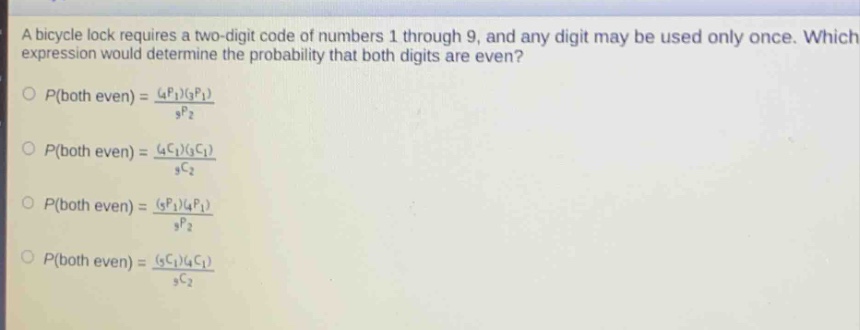
a bicycle lock requires a two - digit code of numbers 1 through 9, and any digit may be used only once. which expression would determine the probability that both digits are even?\n$p(both even)=\frac{(_{4}p_{1})(_{3}p_{1})}{_{9}p_{2}}$\n$p(both even)=\frac{(_{4}c_{1})(_{3}c_{1})}{_{9}c_{2}}$\n$p(both even)=\frac{(_{5}p_{1})(_{4}p_{1})}{_{9}p_{2}}$\n$p(both even)=\frac{(_{5}c_{1})(_{4}c_{1})}{_{9}c_{2}}$\n
Answer
Explanation:
Step1: Find total number of two - digit codes
We are choosing 2 digits out of 9 digits (1 - 9) without repetition. The number of permutations of (n) objects taken (r) at a time is given by ({n}P{r}=\frac{n!}{(n - r)!}). Here, (n = 9) and (r=2), so the total number of two - digit codes is ({9}P{2}=\frac{9!}{(9 - 2)!}=\frac{9!}{7!}=9\times8 = 72).
Step2: Find number of two - digit codes with both even digits
The even digits from 1 - 9 are 2, 4, 6, 8. So there are (n = 4) even digits. We want to choose 2 even digits out of 4 without repetition. The number of permutations is ({4}P{2}=\frac{4!}{(4 - 2)!}=\frac{4!}{2!}=4\times3=12).
Step3: Calculate the probability
The probability (P) of an event is the number of favorable outcomes divided by the number of total outcomes. So (P(\text{both even})=\frac{{4}P{2}}{{9}P{2}}).
Answer:
(P(\text{both even})=\frac{{4}P{2}}{{9}P{2}}), which is the first option (P(\text{both even})=\frac{({4}P{1})({3}P{1})}{{9}P{2}}) (since ({4}P{2}=\frac{4!}{2!}=4\times3 = {4}P{1}\times_{3}P_{1}))