a bicycle manufacturer is studying the reliability of one of its models. the study finds that the…
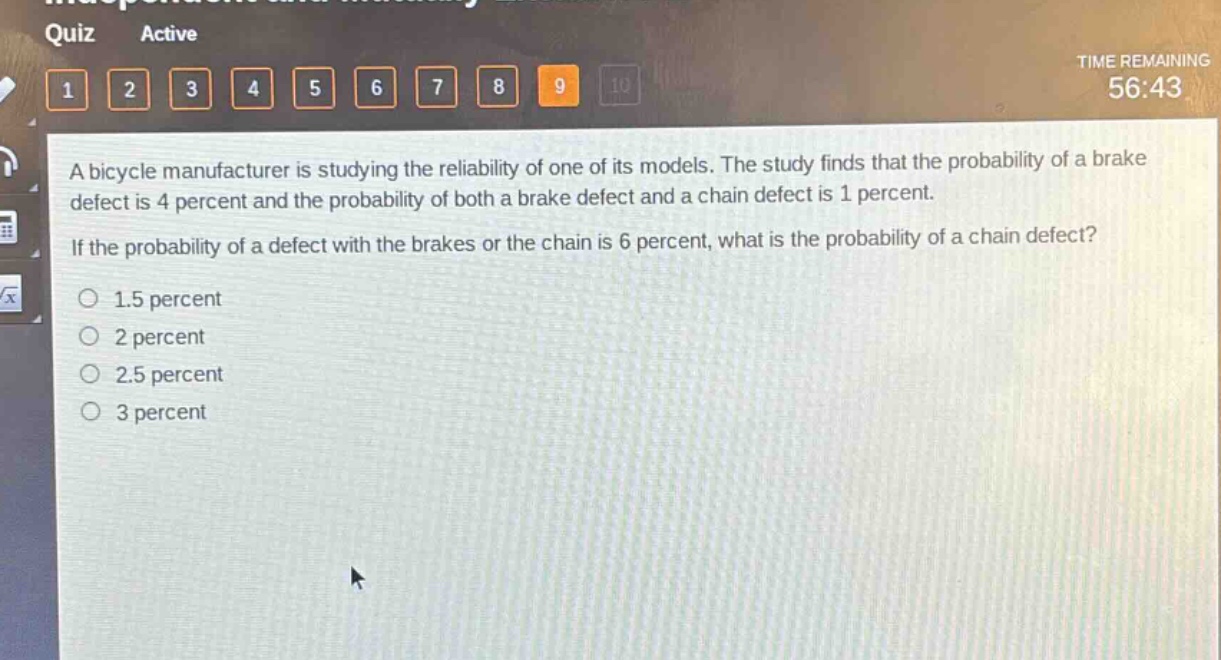
a bicycle manufacturer is studying the reliability of one of its models. the study finds that the probability of a brake defect is 4 percent and the probability of both a brake defect and a chain defect is 1 percent. if the probability of a defect with the brakes or the chain is 6 percent, what is the probability of a chain defect?\n1.5 percent\n2 percent\n2.5 percent\n3 percent
Answer
Explanation:
Step1: Recall the formula for the probability of the union
Use the formula $P(A\cup B)=P(A)+P(B)-P(A\cap B)$, where $A$ is the event of a brake - defect and $B$ is the event of a chain - defect. Let $P(A)$ be the probability of a brake defect, $P(B)$ be the probability of a chain defect, and $P(A\cap B)$ be the probability of both a brake and a chain defect, and $P(A\cup B)$ be the probability of a brake or a chain defect.
Step2: Substitute the given values into the formula
We know that $P(A) = 0.04$, $P(A\cap B)=0.01$, and $P(A\cup B)=0.06$. Substituting into the formula $P(A\cup B)=P(A)+P(B)-P(A\cap B)$, we get $0.06 = 0.04+P(B)-0.01$.
Step3: Solve for $P(B)$
First, simplify the right - hand side of the equation: $0.04 + P(B)-0.01=0.03 + P(B)$. Then, solve the equation $0.06=0.03 + P(B)$ for $P(B)$. Subtract 0.03 from both sides: $P(B)=0.06 - 0.03=0.03$.
Answer:
3 percent